The Story Behind the 10 Core Operating Capabilities of SeniorCRE
Senior Housing & Care is no longer a simple real estate business. It is clinical care, staffing, compliance, family communication, sales velocity, revenue management, maintenance, investor reporting, asset performance, and capital markets — finally operating from one connected operator-controlled operating record.
Senior Housing & Care is no longer a simple real estate business. It is clinical care. It is staffing. It is compliance. It is family communication. It is sales velocity. It is revenue management. It is maintenance. It is investor reporting. It is asset performance. It is capital markets.
And for too long, every one of those functions has lived in a different system.
The problem this graphic solves
- The executive director sees one version of the truth.
- The regional operator sees another.
- The clinical team works from another.
- The investor gets a delayed report.
- The owner sees the financial impact after the damage has already been done.
That is the problem SeniorCRE was built to solve.
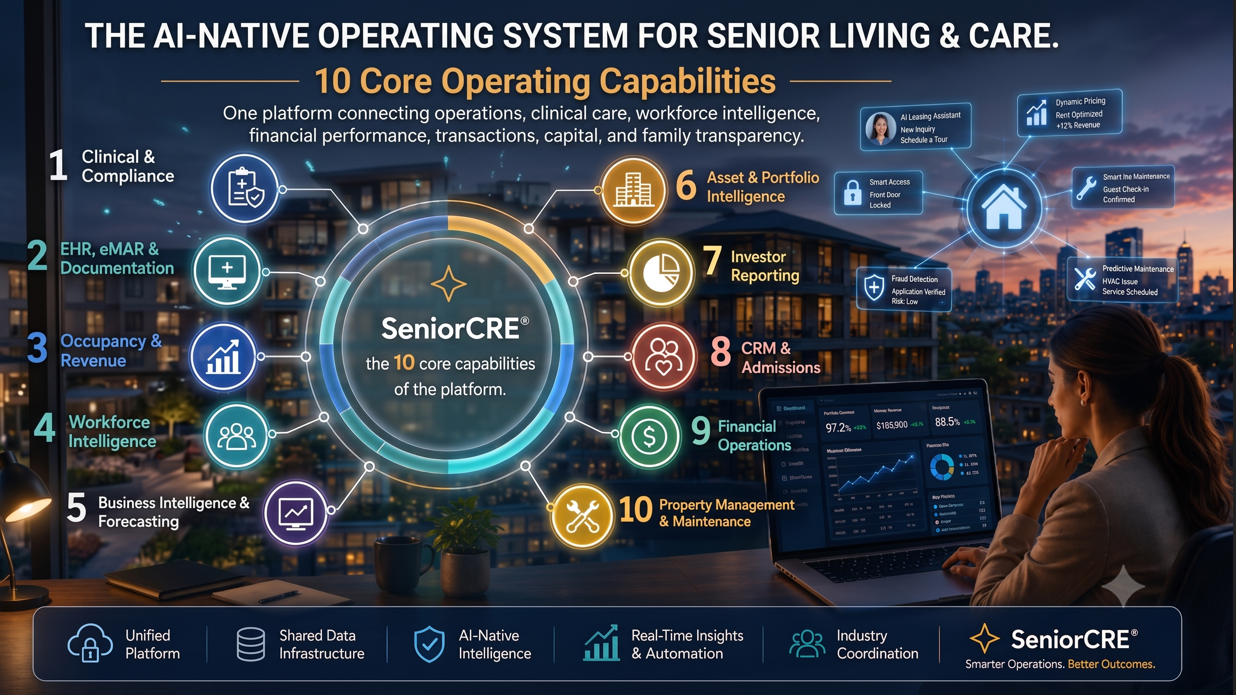
This graphic tells the story of a senior housing & care organization finally operating from one connected operator-controlled operating record. At the center is the SeniorCRE platform — not just another software tool, but the Operating Infrastructure for senior housing & care and care. Around it are the ten critical operating capabilities every modern senior housing & care organization must coordinate if it wants to grow, protect margin, reduce risk, and deliver better care.
The 10 core operating capabilities
Clinical & Compliance
Senior Housing & Care is a care business first. Documentation, survey readiness, care visibility, and regulatory oversight are not back-office details — they are enterprise risks that directly affect residents, operators, and ownership.
EHR, eMAR & Documentation
The clinical foundation that captures resident records, medication workflows, notes, and digital documentation. Without this layer connected to the rest of the business, operators are always reacting late.
Occupancy & Revenue
Census, pricing, conversions, and revenue performance cannot sit in isolation. A 3% drop in occupancy is not just a sales issue — it affects staffing, NOI, valuation, lender confidence, and investor trust.
Workforce Intelligence
Staffing risk, call-outs, turnover patterns, retention pressure, and labor optimization are no longer HR-only issues. They are financial, clinical, and operational issues.
Business Intelligence & Forecasting
Turns fragmented data into forward-looking insight. Instead of waiting for monthly reports, leadership can see trends forming early — before they become expensive.
Asset & Portfolio Intelligence
Gives executives, owners, and capital partners visibility into property performance, portfolio health, asset trends, and NOI impact.
Investor Reporting
Brings transparency to capital. Investors do not simply want a quarterly PDF — they want confidence, performance visibility, and proof that the operator understands the business at the property and portfolio level.
CRM & Admissions
Connects the revenue pipeline to care readiness. Referrals, admissions workflows, family engagement, and move-in velocity all become part of one operational rhythm.
Financial Operations
Ties the numbers back to daily execution — accounting visibility, AP/AR workflows, operating metrics, and expense management.
Property Management & Maintenance
The physical plant is part of resident experience, compliance, operational discipline, and asset value. Work orders, maintenance tracking, and community-level property operations belong inside the same operating infrastructure as care, staffing, revenue, and finance.
These capabilities are not standalone products. They share the same six canonical entities — Resident, Care Plan, Ledger, Shift, Property/Unit, and Entity — through one operator-controlled operating record.
The real story is coordination
That is the power of the SeniorCRE model.
It is not ten separate modules. It is one connected operating environment.
The real story of this graphic is not software. It is coordination.
Senior Housing & Care has been running on fragmented systems while the complexity of the business has exploded. Operators are being asked to deliver better care, higher compliance, stronger staffing, better reporting, improved margins, and greater transparency — often with outdated tools that were never designed to work together.
SeniorCRE brings those pieces into one shared data infrastructure. The result is a platform where operators can see earlier, act faster, coordinate better, and report with greater confidence.
Operator-controlled operating record. Shared data infrastructure. Industry coordination.
One operating environment connecting clinical care, workforce, finance, transactions, capital, and family transparency for senior housing & care.
The next era of senior housing & care infrastructure
- An operator-controlled operating record.
- A shared data foundation.
- A clearer operating model.
- A better way to run senior housing & care.
Explore the upstream surfaces that bring these capabilities to life: the SeniorCRE Clinical Platform, the capital layer, and the institutional trust markers that translate operating reality into capital-grade reporting.
Frequently asked questions
What are the 10 core operating capabilities of SeniorCRE?
Clinical & Compliance; EHR, eMAR & Documentation; Occupancy & Revenue; Workforce Intelligence; Business Intelligence & Forecasting; Asset & Portfolio Intelligence; Investor Reporting; CRM & Admissions; Financial Operations; and Property Management & Maintenance — all running on one shared operator-controlled operating record.
Why does coordination matter more than software?
Senior Housing & Care has been running on fragmented systems while the complexity of the business has exploded. Operators are being asked to deliver better care, higher compliance, stronger staffing, better reporting, improved margins, and greater transparency — often with outdated tools that were never designed to work together. The advantage of a unified operating model is not features; it is coordination across clinical, financial, workforce, and capital workflows.
Is SeniorCRE a collection of modules or a single platform?
It is one connected operating environment. The same Resident, Care Plan, Ledger, Shift, Property/Unit, and Entity records power every capability — so clinical, financial, workforce, and capital views reconcile against the same operator-controlled operating record.
Who benefits from the unified operating model?
Executive directors, regional operators, clinical teams, owners, lenders, and investors all see the same operating reality. Operators can see earlier, act faster, coordinate better, and report with greater confidence.
Key Takeaways for Operators and Investors
- Senior Housing & Care is no longer a simple real estate business — it spans clinical, workforce, capital, and asset performance.
- These capabilities are coordinated by one operator-controlled authority model.
- Governed data infrastructure lets operators see context earlier, authorize decisions, and report with confidence.
These insights are derived from publicly available industry research and cited sources.
Get this article as a PDF
Save it for your team, share it with stakeholders, or read it offline. No email required.
Frequently Asked Questions
- What are the 10 core operating capabilities of SeniorCRE?
- Clinical & Compliance; EHR, eMAR & Documentation; Occupancy & Revenue; Workforce Intelligence; Business Intelligence & Forecasting; Asset & Portfolio Intelligence; Investor Reporting; CRM & Admissions; Financial Operations; Property Management & Maintenance — all governed through operator-controlled definitions, authority, reconciliation, and lineage.
- Is SeniorCRE ten modules or one platform?
- One connected operating environment. Resident, Care Plan, Ledger, Shift, Property/Unit, and Entity records preserve authority and lineage so clinical, financial, workforce, and capital views reconcile by decision context.
- Why does coordination matter more than features?
- Senior Housing & Care complexity has exploded while systems stayed fragmented. The advantage of a unified operating model is not feature count — it is coordination across clinical, financial, workforce, and capital workflows.