See what changes when machines enter the decision chain.
OPERATOR · AUTHORITY · CHAIN™
Two leaders bring different numbers. Who decides which one the organization runs on?
The Operator Authority Chain™ — who gets to decide, for which field, for which purpose. The decision already belongs to the operator; the chain is where the exercise of it is written down.
See the mechanism · Census dispute, month-end
Illustrative model
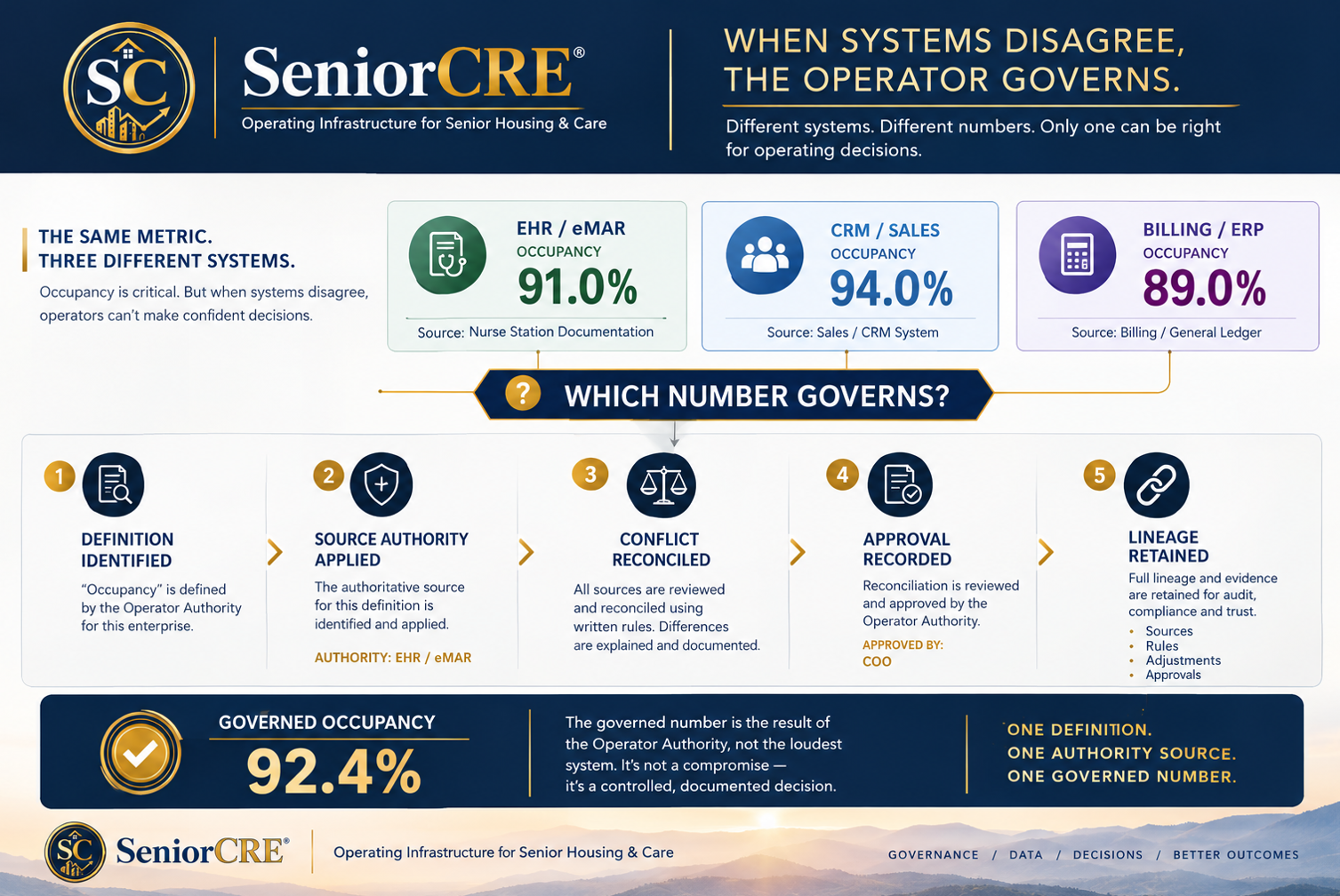
3 systems → 1 governed number
One number governs. The other two become variances, not arguments.
Source authority is named per field before the dispute, so reconciliation is a rule that runs instead of a meeting that recurs.
Illustrative exemplar of the governed workflow, modeled — not measured from an operator deployment. No operator production integrations as of September 29, 2026.
The operating record is the governed record the organization decides from. The Operator Authority Chain™ is the mechanism that makes organizational decision rights explicit: evidence, disagreement, authority, the Governing Record, intelligence, then execution. SeniorCRE is the operating infrastructure designed to operationalize and preserve the operator’s authority assignments.
I · The moment
Two leaders. Two numbers. One decision that does not get made.
Operations brings one occupancy figure. Finance brings another. Both are defensible. Both come from systems the organization paid for and trusts. There is a pause, and then somebody asks the only question that matters.
“So which number are we running on?”
In most organizations that question has no owner. It gets settled by seniority, by fatigue, or by whoever is more certain that morning. Then the meeting adjourns, the decision is deferred, and the same conflict returns next month with the same participants.
II · The distinction
Authority is not who is senior. It is who holds decision rights on truth.
Hierarchy is not authority.
The most senior person in the room can end the argument. That is not the same as being the person whose number the organization is supposed to run on.
Expertise is not authority.
The person closest to the data usually knows most about it. Knowing the number is not the same as holding the right to declare it.
Possession is not authority.
Whoever built the spreadsheet, ran the export, or integrated last becomes the de facto source. Nobody chose that. Sequence chose it.
Decision rights are authority.
Authority is a named, written, standing assignment: this role determines this truth for this entity in this period — before the disagreement, not during it.
III · The decision rights
Six rights. Assign them once, and the argument stops being a meeting.
This is not a heroic process. It is a discipline — the same six rights, assigned to named roles, applied to every governed figure.
01
Propose
Who may put a number forward?
A figure enters the record as a proposal attached to its source, not as a claim asserted in a meeting.
02
Validate
Who confirms it against the approved definition?
Validation checks the figure against the definition the organization approved — not against the version the team prefers.
03
Reconcile
Who resolves it when sources disagree?
Conflict resolves by a standing rule the operator wrote in advance, so reconciliation is a procedure that runs rather than a debate that recurs.
04
Approve
Who declares the number the organization will run on?
One named role, per governed figure, per period. This is the link most organizations have never made explicit.
05
Document
What is retained about the decision?
The record version, the definition version, the contributing sources, the resolving rule, the approving role, the time.
06
Own
Who answers for the outcome?
Accountability follows the approval. An outcome nobody owns is not a governed decision — it is a consensus that dissolved.
Governed data decides which number wins. Decision rights decide who may set operating truth, who resolves cross-functional conflict, and who answers for the result. That is not data governance. That is an operating constitution.
IV · The inversion
Governance is not drag. Governance is velocity.
Leaders assume governance slows decisions because they have only experienced governance as review. Decision rights do the opposite: they remove the debate that precedes every decision. The organization stops relitigating the number and starts acting on it.
Without decision rights
Each decision reopens the question of which number is real. Latency is spent on arbitration, and the same arbitration repeats every cycle.
With decision rights
The number arrives already governed. The meeting spends its time on the decision, not on the reconciliation that should have preceded it.
Illustrative design intent. SeniorCRE publishes no measured operator decision-latency results.
V · The threshold
At ten communities, relationships patch the gaps. At fifty, they do not.
Ten communities
Conflicts resolve informally. Two people who trust each other agree on a number, and the organization inherits their judgment.
Twenty-five communities
The informal network thins. Regions begin carrying their own definitions, and the portfolio view stops reconciling to the operating view.
Fifty communities
Nobody knows everybody. Judgment cannot be transmitted by relationship, so authority must be written down or it does not exist.
Explicit decision governance is not a management preference. It is what scale requires once informal arbitration stops reaching every building.
VI · The boundary
AI can recommend. Authority owns accountability.
An assistant can surface a conflict faster than any analyst. It cannot hold decision rights, because it cannot be accountable for an outcome. Automation that is allowed to approve is not efficiency — it is an unassigned decision right.
AI may
Detect that sources disagree.
Propose the resolution the approved rule implies.
Assemble the lineage behind a figure.
Only a named role may
Approve the definition.
Declare the number the organization runs on.
Own the outcome of the decision taken on it.
Govern the truth before you automate the decision. Clinical, staffing and regulatory decisions remain with licensed and accountable humans; no SeniorCRE surface makes an autonomous clinical decision.
Clinical authority governs clinical fields; no financial override
Clinical leadership, with named escalation and human review
Reported financials
Finance — the general ledger remains the financial source of authority
Reconciliation from operating activity to financial consequence, with lineage
CFO
Illustrative assignment of governance responsibility. Operators approve their own definitions, source authority and reconciliation rules; clinical fields stay under authorized clinical authority with mandatory human review.
Illustrative exhibit · synthetic scenario
One decision, carried on the record from strategy to result.
The question is rarely "how do we raise census." It is which mix of census, payer, acuity and staffing produces the best sustainable result for this asset — and who was authorized to decide. Visibility for ownership follows from the record; it is not the product.
01Asset strategyDATAOwnership intent for this community: sustainable margin over maximum occupancy.
02Operating prioritiesDATAProtect skilled mix, stabilize nursing coverage, hold agency use flat.
03Governed evidenceTRUTHCensus, payer mix, acuity and scheduled coverage reconciled under the approved definitions — conflicting source values preserved, not overwritten.
04Available leversDECISIONAdmit two additional long-term Medicaid residents now, or hold beds for expected skilled referrals and fix a recurring uncovered night shift first.
05Decision logicDECISIONFuller is not automatically healthier. A shift that goes uncovered every week is a capacity problem, not a staffing event.
06Operator decisionDECISIONExecutive director, within delegated authority: hold the beds for 14 days, convert the recurring shift to a posted position. Rationale recorded.
07ExecutionEXECUTIONPosting opened, referral sources notified, a review date set on the record.
08Financial resultEXECUTIONAt review, the outcome is compared with the projection the decision relied on. The variance is kept on the record, whichever way it falls.
Illustrative only. The community, figures and decision are synthetic and describe how a governed decision record is designed to work — not product output and not a measured result. The record is designed; the first community implementation is next.
Governance doctrine · As of August 23, 2026
The operating week
Four systems, one resident, one Tuesday
The governance gap is rarely dramatic. It shows up as a normal Tuesday in which every system is working correctly and the operator still cannot say which number is true.
06:40
A med-tech calls out. Scheduling fills the shift with agency at premium rate. The labor system records a filled shift. Nobody records that the shift is now staffed by someone who has never met the residents on that hall.
Which system holds the fact that acuity coverage changed, not just headcount?
09:15
A resident returns from hospital with three medication changes and a higher assistance need. The clinical record is updated. The care agreement, the billing rate, and the staffing model are not — because each lives in a different system with a different owner.
Who is accountable for the gap between care delivered and care billed?
13:30
The sales system shows two move-ins this week. The billing system shows one. Both are correct: one resident moved in on a partial month under a concession nobody logged as a concession.
When systems disagree about census, whose number goes to the lender?
16:00
The executive director is asked for a same-day answer on contract labor exposure. The answer is assembled by hand from three exports and a phone call, and it will be assembled again next week, differently.
Is the reported number a governed fact or the most recent reconstruction of one?
18:20
A regional leader signs off on the weekly report. The numbers are defensible. They are also not reproducible: the same question asked next Tuesday, by a different person, will return a different figure.
What does the operator actually accept as truth, and can they prove it later?
What is supposed to change
DESIGN INTENT
None of the systems in that day is broken. Each is authoritative inside its own boundary and silent outside it. The operator is left arbitrating between them without a record of the arbitration — and AI applied on top of that arrangement inherits the disagreement rather than resolving it.
SeniorCRE is designed so that the operator, not a vendor, governs the operating record across those systems: which source is authoritative for a given fact, what the business accepts as true, who decided, and when. Operators can retain the systems they choose to keep. What changes is that the resolution becomes a governing determination in the Governing Record instead of an undocumented judgment call.
This is described as design intent, not deployed operator results. Maturity for each capability is stated on the surface that describes it.
When systems disagree, the operator governs.
Composite illustration. Not a customer account, deployment, or case study. No operator data, named operator, or outcome figure is represented.
Senior housing & care operators do not suffer from a shortage of systems. They suffer from an unresolved question about which system is allowed to be right. Every platform in the stack records something true inside its own boundary, and the boundary is exactly where accountability disappears.
That unresolved question is the governance gap. It is not an integration problem, because the data usually moves. It is not a reporting problem, because the dashboards usually render. It is an authority problem: nothing in the stack states, in advance and in writing, which record governs, which definition applies, and what a decision was based on. Connectivity gives the organization more context. Authority determines what governs.
Your systems record transactions. The operator declares which of them governs each figure — SeniorCRE keeps that declaration.
— SeniorCRE governance doctrine
The construct
The six links
Link 01
EVIDENCE
— What did each source assert?
What did each source assert? EVIDENCE preserves what each system said, when, and under which definition.
Where it breaks: The chain breaks here when the original assertion is overwritten by whichever export loaded last, so no one can reconstruct what each system reported.
Hover or focus a link to preview it. Select a link to keep it open.
When systems disagree, the operator governs.
Two forms of operator authority: data authority — who decides what is true? — and architecture authority — who decides what systems remain or are replaced? Both answers are the operator.
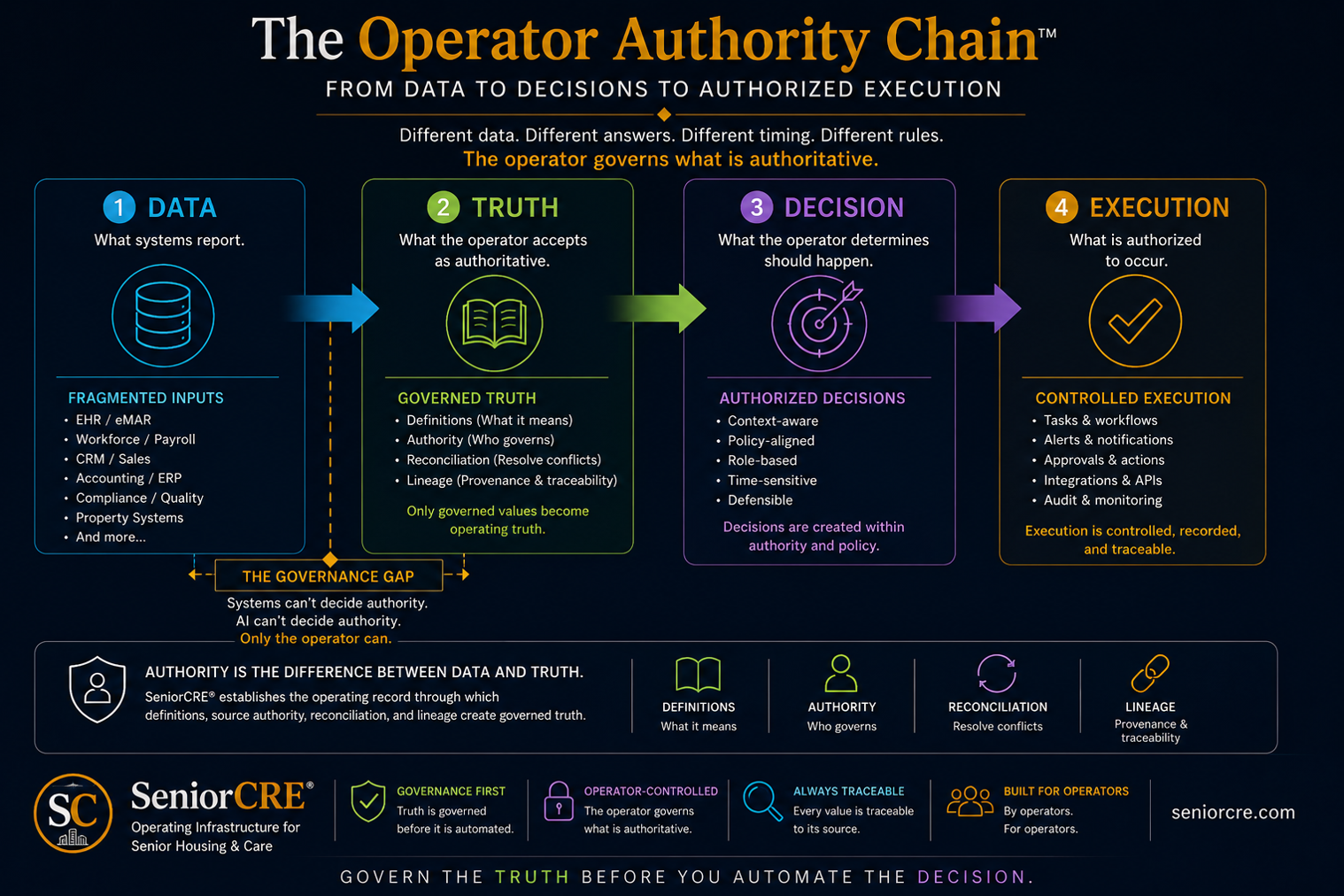
The governing mechanism: EVIDENCE → DISAGREEMENT → AUTHORITY → GOVERNING RECORD → INTELLIGENCE → EXECUTION. The critical transition is DATA → TRUTH, where definitions, source authority, reconciliation and lineage decide what the operator accepts as authoritative. Nothing is automated before the truth is governed.
Illustrative governance diagram. It depicts the governance model and design intent, not operator results, customer deployments, production performance, or verified outcomes.
01
EVIDENCE
What did each source assert?
What did each source assert? Every approved system — EHR, PMS, payroll, time and attendance, CRM, general ledger, pharmacy, survey files — can record a valid fact about the same building, resident, shift or day. EVIDENCE preserves what each system said, when it said it, and under which definition, before anything is reconciled.
Where it breaks
The chain breaks here when the original assertion is overwritten by whichever export loaded last, so no one can reconstruct what each system reported.
02
DISAGREEMENT
Where do consequential assertions conflict?
Where do consequential assertions conflict? When legitimate sources disagree, SeniorCRE does not average, overwrite or let AI choose the answer. DISAGREEMENT is exposed, with each competing assertion and its evidence kept side by side.
Where it breaks
The chain breaks here when a conflict is silently resolved, so no one can see that two systems disagreed.
03
AUTHORITY
Who is authorized to determine what governs for this purpose?
Who is authorized to determine what governs for this purpose? AUTHORITY names the operator role entitled to set the governing definition and source for a field, an entity, a purpose and a period. The operator holds that authority; the software does not.
Where it breaks
The chain breaks here when authority is implicit, and the number a report uses depends on which analyst pulled it.
04
GOVERNING RECORD
What was determined to govern, why, by whom, and with what lineage?
What was determined to govern, why, by whom, and with what lineage? The authorized determination is the event that creates or updates the GOVERNING RECORD. The decision, its rationale, the evidence relied on, the authorizing role, the timestamp, any later supersession and the lineage are all properties of that record. A unified record consolidates data; a Governing Record states which assertion governs for a defined purpose and why.
Where it breaks
The chain breaks here when a decision cannot be traced back to the evidence and authority behind it.
Systems hold facts. Decision layers organize evidence. The Operator-Controlled Operating Record establishes what has authority to govern.
05
INTELLIGENCE
What can be understood, recommended or reasoned from governed context?
What can be understood, recommended or reasoned from governed context? INTELLIGENCE, including AI agents, reasons only from the Governing Record, never from raw disagreement between systems. Intelligence does not establish authority; it operates within authority the operator has already established.
Where it breaks
The chain breaks here when an agent reasons from ungoverned data and its recommendation inherits a conflict no one resolved.
06
EXECUTION
What authorized action follows?
What authorized action follows? EXECUTION occurs within established authority and is recorded against the Governing Record — the schedule actually worked, the rate actually billed, the admission actually recorded — so the next determination begins with evidence rather than intention.
Where it breaks
The chain breaks here when execution is measured in a different system than the one that authorized it.
Governing principles
Authority runs in one direction
DATA informs TRUTH. TRUTH constrains DECISION. DECISION is proved by EXECUTION. Nothing downstream is permitted to redefine something upstream after the fact.
The operator holds the chain, not the vendor
The operator approves which source governs, how conflicts resolve and what each metric means; those choices are not vendor defaults. A governed data platform can govern the technology; an Operator-Controlled Operating Record governs what the business accepts as truth.
Every link is nameable
For any figure on any screen, an operator should be able to state which system emitted it, which rule resolved it, which definition version applied, and who authorized the action taken on it.
The operator chooses what stays
The chain can govern an EHR, PMS or payroll platform the operator retains, and it can govern domains the operator chooses to run on SeniorCRE. It does not ask different systems to agree; it records which authority governs each decision.
Disagreement is expected, not exceptional
Systems will disagree. The chain exists so that disagreement resolves by governance rather than by escalation.
How the chain fails
Two numbers, one board meeting
Operations reports one occupancy figure, finance reports another, and the meeting spends its first twenty minutes deciding which one is real instead of deciding what to do.
A definition that moved
A metric definition changes inside one platform. Prior-period reporting silently changes with it, and there is no versioned record of what the definition was when the decision was made.
An AI answer with no lineage
An assistant produces a confident number. It cannot name the source system, the survivorship rule, or the record version behind it, so the number cannot be used where consequence attaches.
Authority delegated to whoever integrated last
The system that most recently wrote to a shared field becomes the de facto authority for that field. Nobody chose that; the integration order chose it.
Which number governs?
The Operator Authority Chain™ in operation. Each system is correct inside its own boundary. The governed figure is governed because the approved census definition assigns source authority to the EHR/eMAR for that entity, time and period — reconciled under written rules, approved by a named role, and retained with full lineage. It is not an average of the three readings and not an arbitrary selection among them.
Illustrative governance example. The figures shown are design intent used to demonstrate the governance mechanism — not operator results, customer deployments, production performance, or verified outcomes.
The chain, worked through
The construct is easiest to judge against the disputes operators actually have. Each example below is written as an illustration of the governance model, not as a report of results achieved at a customer site.
Example · Census
Two occupancy numbers, one covenant report
The PMS shows a unit released on the day the resident moved out. The EHR shows the same unit occupied until discharge documentation closed two days later. Finance bills from a third calendar. Three defensible numbers describe one month.
EVIDENCEAll three emissions are captured and labeled with the system, the entity, the field and the timestamp — nothing is discarded and nothing is silently overwritten.
AUTHORITYThe operator has already named the PMS as field-level authority for unit status, with a survivorship rule that defers to clinical discharge date when the two differ by more than 24 hours.
GOVERNING RECORDThe covenant report is generated against occupancy definition v4, with the record version and the resolving rule attached to the submitted figure.
EXECUTIONBilled days are written back against the same governed record, so the variance between reported and billed occupancy is a measured number rather than a disputed one.
The lender receives one number the operator can defend line by line, and the same number reconciles to the rent roll six months later.
Example · Labor
Acuity rose, the budget did not move
Assessments in the EHR show acuity climbing on one wing. Scheduling is built from a budget set last quarter. Agency hours absorb the difference, and the overage surfaces in the month-end close — after the money is spent.
EVIDENCEAssessment output, worked hours from time and attendance, agency invoices and payroll all land against the same building, unit and pay period.
AUTHORITYHPRD and agency percentage each resolve to one operator-approved definition, so the care-side and finance-side views of the same wing stop describing different weeks.
GOVERNING RECORDThe staffing change carries the acuity record version it was based on and the role that authorized the incremental spend.
EXECUTIONWorked reality is compared to the authorized plan on the same record, so the question becomes whether the plan held — not whose report is correct.
The overage is explainable at the time it happens, and the next budget cycle inherits evidence instead of anecdote.
Example · AI answers
A confident number with nothing behind it
An assistant reports margin per occupied unit for a region. It cannot say which system supplied revenue, which definition of occupied applied, or what the record looked like when the answer was produced. The number is unusable anywhere consequence attaches.
EVIDENCERetrieval is restricted to approved, attributed sources rather than a flattened copy of everything.
AUTHORITYThe assistant answers from governed definitions, so it cannot invent a fifth version of margin.
GOVERNING RECORDThe answer is returned with source, survivorship rule, definition version and record version attached — or it is returned as insufficient.
EXECUTIONAny action taken on the answer inherits that lineage, so the decision can be replayed later exactly as it was made.
Intelligence becomes admissible in the room where the decision is signed, instead of being demoted to a talking point.
How SeniorCRE delivers the chain
The operating record is the governed record the organization decides from. The Operator Authority Chain™ is the mechanism that makes organizational decision rights explicit: evidence, disagreement, authority, the Governing Record, intelligence, then execution. SeniorCRE is the operating infrastructure designed to operationalize and preserve the operator’s source assignments, conflict rules, versioned definitions and decision lineage above the systems already in place.
EVIDENCE
Source-authority mapping
SeniorCRE catalogs the fields each approved system emits and records the operator’s field-level authority assignments as governed configuration — one authoritative source per field, per entity, written down rather than inferred from integration order.
AUTHORITY
Survivorship & definition governance
SeniorCRE holds the operator-approved survivorship rules and versioned operating definitions — occupancy, HPRD, agency percentage, PRPM, length of stay, revenue per occupied unit — so a prior-period figure can be reproduced exactly as it read then.
GOVERNING RECORD
Decision lineage & traced decisions
SeniorCRE binds staffing, rate, admissions, compliance and capital decisions to the record version, definition version, contributing sources and authorizing role that stood behind them at the moment of authorization.
EXECUTION
Evidence of effect
SeniorCRE writes executed reality back against the same governed record that authorized the action, so variance between plan and outcome is measured on one record instead of argued across four.
Operators can retain PointClickCare®, MatrixCare®, Yardi®, payroll and CRM where the operator chooses to retain them. SeniorCRE does not ask those systems to agree with each other; it gives the operator the authority layer that decides what the business accepts as true when they do not. Every statement on this page carries a BUILT status in the ledger below.
Frequently asked questions
How does the Operator Authority Chain™ work?
The operating record is the governed record the organization decides from. The Operator Authority Chain™ is the mechanism that makes organizational decision rights explicit. In the six-step executive sequence — Evidence › Disagreement › Authority › Governing Record › Intelligence › Execution — it is the Authority step: each system’s reading is preserved as evidence, material disagreements are surfaced, the operator decides which definition and source govern for the purpose, and that governing determination is recorded in the Governing Record with its lineage. SeniorCRE Intelligence reasons from that record, and execution acts only within established limits. Model confidence never creates organizational authority. SeniorCRE is the operating infrastructure designed to operationalize and preserve those authority assignments above the systems the operator chooses to retain. Statements here carry BUILT status as of the page date; they are not a representation of an operator production deployment.
Who is the Operator Authority Chain™ for?
It is built for the operators, owners and capital allocators who are responsible for what the business accepts as true in senior housing & care. That includes regional operators with dozens of buildings, REITs and family offices managing portfolio performance, compliance officers defending survey and staffing filings, and CFOs and CIOs who need governed evidence to support capital decisions, lender reporting and board governance. It is especially useful where multiple systems — EHR, PMS, payroll, time and attendance, CRM, GL — already work, but disagree on the same field.
What makes it different from data governance or integration?
Connectivity gives the organization more context. Authority determines what governs. The Operator Authority Chain™ answers the unresolved question: when systems disagree, who decides which information the organization accepts for this decision, and why? The chain names source authority, records how conflicts resolve, versions definitions and ties decisions to the record state at the moment they were made. SeniorCRE clinical record surfaces are built; medication administration and eMAR remain roadmap — not built. It can run alongside incumbent systems, reading one direction only. Either way the operator holds authority over the record.
Compliance FAQ — definitions, limitations and support
Compliance teams ask the chain three questions about every link: what does the term actually mean, what does it not do, and what does SeniorCRE do about it. The answers below are stated as design intent and architectural doctrine as of August 23, 2026, and are not compliance certifications, legal advice, or representations of outcomes achieved at a customer site.
EVIDENCE
What is “source authority,” and does naming it make a filing defensible?
Definition
Source authority is the operator’s written assignment of which approved system governs a specific field for a specific entity — for example, the EHR governs resident census status while payroll governs paid hours. It is configuration approved by the operator, not a default inherited from whichever interface ran last.
Limitation
Naming source authority does not correct upstream data entry, does not make a filing accurate on its own, and is not a regulatory determination. It documents which system the operator treats as authoritative; the operator remains responsible for the filing and for the accuracy of the underlying records.
How SeniorCRE supports this link
SeniorCRE is designed to catalog emitted fields per system and hold the operator’s field-level authority assignments as governed, reviewable configuration with a change history.
AUTHORITY
What are survivorship rules, and how do they relate to CMS staffing and census reporting?
Definition
When two authoritative-looking records disagree, the operator needs a written instruction for which value governs — based on source precedence, recency, completeness or explicit operator review. That instruction is a survivorship rule. Applied to staffing and census, it determines which hours and occupied-day count the business accepts before a report is produced.
Limitation
Survivorship rules are an operator governance mechanism, not a substitute for PBJ, MDS or state survey submission processes, and they do not validate data against CMS systems. Nothing on this page should be read as a compliance certification, legal advice, or a guarantee of survey, audit or covenant outcomes.
How SeniorCRE supports this link
SeniorCRE is designed to hold operator-approved survivorship rules and versioned operating definitions — occupancy, HPRD, agency percentage, PRPM, length of stay — so a prior-period figure can be reproduced as it read at the time.
GOVERNING RECORD
What does decision lineage mean for an audit, survey or lender request?
Definition
Decision lineage is the binding of a decision to the exact record state that supported it: record version, definition version, contributing sources, timestamp and authorizing role. It answers “what did we know, under which definition, when we decided.”
Limitation
Lineage evidences the operator’s own process. It does not determine how a surveyor, auditor or lender will evaluate that process, does not replace the retention obligations of source systems, and is not a warranty that a request will be satisfied.
How SeniorCRE supports this link
SeniorCRE is designed to attach that lineage to staffing, rate, admissions, compliance and capital decisions so the basis of a decision can be produced without reassembling exports.
EXECUTION
How is executed reality verified, and what is out of scope?
Definition
Execution closes the chain by writing what actually happened back against the governed record that authorized the action, so plan-to-outcome variance is measured on one record instead of reconciled across several.
Limitation
SeniorCRE measures variance against the operator’s governed record; it does not operate clinical care, does not act as the payroll system of record, and does not issue regulatory submissions on the operator’s behalf. Source systems remain the transactional systems of record.
How SeniorCRE supports this link
SeniorCRE is designed to record executed outcomes against the authorizing record version and surface variance as a governed fact for board, lender and compliance review.
ACROSS THE CHAIN
Where do privacy and PHI obligations sit in the chain?
Definition
Governance of authority is separate from governance of access. The chain decides which record governs; access controls, minimum-necessary handling and audit logging decide who may see it.
Limitation
Privacy and security items on this page are BUILT, not attested. They are not a representation of a completed third-party attestation, and SeniorCRE does not claim SOC 2 certification or its own SOC 2 report.
How SeniorCRE supports this link
SeniorCRE is designed around role-scoped access, community-level scoping and audit logging so PHI-bearing fields stay governed as they move through the chain. Contractual terms, including any business associate arrangements, are handled in the agreement — not by this page.
ACROSS THE CHAIN
Does asserting the chain require replacing compliance systems already in place?
Definition
No replacement is required by default. The chain is asserted above the stack: EHR, PMS, payroll, time and attendance, CRM and GL keep recording transactions; the operator governs which of their emissions the business accepts as true. SeniorCRE can also assume selected system-of-record functions — including the clinical record — where the operator deliberately chooses that configuration. Replace only by choice.
Limitation
Integration availability varies by system and contract, and no integration should be assumed enabled in an operator production environment from this page. Statements here carry BUILT status as of August 23, 2026.
How SeniorCRE supports this link
SeniorCRE is designed to sit above existing platforms as an authority layer, so compliance workflows continue in their current systems while the operating record governs what is reported.
Scope of the mark
Operator Authority Chain™ denotes the governance and survivorship construct described on this page — the operator's authority over the path from data to truth to decision to execution, including the lineage rules that determine which record governs when systems disagree. It is not a role-based approval workflow, and it is not a synonym for integration. The related architectural artifact is the Operator-Controlled Operating Record.
Status
The governance model on this page is stated as architectural doctrine. Each claim is marked BUILT in the status ledger below. Nothing here is a representation of an operator production deployment or of results achieved at a customer site.
Before a briefing
Three ways to test the argument without talking to us
An executive briefing is the right next step once the argument holds. It should not be the first step. These three surfaces are self-serve, and none of them gate the substance behind a form.
Diligence questions the chain is designed to answer
For occupancy, agency percentage and HPRD, which single system holds field-level authority — and where is that written down?
When two systems disagree on the same field, what rule resolves it, and who approved that rule?
Is each operating definition versioned, so a prior-period report can be reproduced exactly as it read then?
Can a decision — a staffing plan, a rate action, an admissions hold — be replayed against the record state at the moment it was authorized?
Is execution written back against the same governed record that authorized it, or measured somewhere else?
When an AI surface answers, does the answer carry source, rule, definition version and record version?
If the operator changes vendors, does the governed definition layer travel with the operator?
Claim status: what is proven, what is designed
Status as of September 29, 2026 (last modified 2026-09-29)
SeniorCRE claim evidence step and proof class by claim, as of September 29, 2026
Claim
Evidence step
What is true today
Proof to inspect
Operator and portfolio workspace foundation built (roles, hierarchy, entity tree).
Validated
Provisioning controls have been exercised repeatedly in controlled SeniorCRE conditions, including the operator onboarding wizard. Not yet performed for an operator in production; no standard duration is published.
Control test record; synthetic or de-identified data; no operator PHI.
Single-community acceptance boundary.
Architecture designed
A gate sequence derived from the migration and acceptance model. No community has gone live for an operator, so no observed duration exists.
Written deployment plan and acceptance-gate model. No execution record exists.
Portfolio-wide rollout acceptance across multi-community scope.
Architecture designed
A wave-cadence model from the deployment plan. Sequencing depends on community count, system count, data condition, source access, and operator authority decisions. Not a completed rollout.
Written deployment plan and acceptance-gate model. No execution record exists.
Connectors to PointClickCare®, MatrixCare®, Yardi®, and QuickBooks®.
Validated
Ingestion and normalization exercised against synthetic and de-identified extracts in controlled SeniorCRE conditions. No third-party integration is live in operator production.
Control test record; synthetic or de-identified data; no operator PHI.
The Operator-Controlled Operating Record is designed and not yet implemented in any community. Authority rules, reconciliation, and field-level lineage are design intent; synthetic examples do not establish working governance.
Written deployment plan and acceptance-gate model. No execution record exists.
Clinical configuration: SeniorCRE as clinical system of record, or alongside an incumbent eMAR read one direction only.
Architecture designed
Designed, not built for operator use. SeniorCRE's native medication administration and eMAR are roadmap and not built; the read-only configuration alongside an incumbent eMAR depends on the Operator-Controlled Operating Record, which is designed and not yet implemented in any community. One authoritative medication record at all times is a design rule.
Written deployment plan and acceptance-gate model. No execution record exists.
Barcode-verified administration with an automated five-rights check at the point of medication pass.
Architecture designed
Not built. Corrected September 7, 2026: earlier pages, operator training guides, and generated answers described this control as running, which was false. Implementation boundary: four of the five medication scan surfaces open a camera preview with no decoder and match only a manually typed NDC; one mobile surface decodes frames through the browser-native BarcodeDetector API where the browser supports it (Chromium/Android; not iOS Safari, not most desktops) and compares the NDC alone. No decoding library is bundled, no surface verifies resident, dose, route, or time, and no scan result blocks an administration. The five rights are verified by the administering clinician, not by SeniorCRE.
Build-queue entry with scope and dependencies. No implementation exists.
Live write-back into operator payroll and scheduling systems.
Architecture designed
Specified and in the build queue. Read-side ingestion only today.
Build-queue entry with scope and dependencies. No implementation exists.
Implementation effort required from the operator.
Architecture designed
Deployment is staged, not effortless: platform access, source access, authority rules, reconciliation, security review, and any history migration are scoped work with operator-side effort. Any claim of zero implementation would be false.
Written deployment plan and acceptance-gate model. No execution record exists.
Validated
Controls can be shown in controlled SeniorCRE conditions using synthetic or de-identified data only.
Architecture designed
Specified and sequenced by readiness and acceptance gates — but not yet executed with an operator. Not a duration claim.
Architecture designed
Specified and in the build queue. No built capability exists to demonstrate.
Status and evidence class as of September 29, 2026. SeniorCRE has no operator-production deployment. Public timing is gate-based and operator-specific; no standard go-live duration is published. Maintained and reviewed by John Hauber, Founder, SeniorCRE, LLC. A medication-safety control was described on earlier pages as running when it was not; that correction is published in full at /medication-safety-claim.
Asserting the chain over an existing stack
1
Inventory emissions
Catalog every approved system and the fields it emits about residents, units, shifts, revenue and compliance events.
2
Assign field-level authority
For each governed field, name one authoritative source per entity and record the assignment as operator-approved configuration.
3
State how conflicts resolve
Write the rule in advance — source precedence, recency, completeness or explicit operator review. That written conflict rule is the survivorship rule.
4
Version the definitions
Occupancy, HPRD, agency percentage, PRPM and length of stay each get one approved definition with a version history.
5
Bind decisions to lineage
Attach record version, definition version and authorizing role to staffing, rate, admissions and capital decisions.
6
Close the loop on execution
Write executed reality back against the governed record so variance is a fact rather than an argument.
Related Institutional Resources
The Operating Record
Manifesto
Open Data Governance Center
AI Governance
Platform Architecture
Read the book: Coherence Before Intelligence
What makes an operating record governed
“Governed” means more than approved
A record can be complete, auditable, evidence-backed and human-attested and still leave an enterprise question unanswered: which definition had authority to govern this decision?
Senior housing & care enterprises operate across clinical, workforce, occupancy, compliance, financial and capital systems. Those systems can produce different values without any system being wrong. An Operator-Controlled Operating Record preserves those facts, establishes the applicable definition and authority, and records why one meaning governed a particular decision.
A record is not governed merely because:
—The data is centralized.
—Records are unified, matched, merged or deduplicated.
—Institutional context is remembered.
—Evidence is attached.
—A person approved something.
—Every change is logged.
—AI has permissions.
—Workflows follow rules.
—The record is auditable.
Those are important controls, and increasingly standard across enterprise software. Nothing here suggests they are easy or that they are ours. Governed operating truth requires something further.
Seven objects the operator must establish
01Definition
What exactly does the fact mean?
The metric, entity, period and measurement moment are written down and approved by the operator — not inherited from whichever system happened to produce the number.
02Source authority
Which source is authorized for that definition?
A named system holds authority for that definition, and the reason it holds authority is recorded. Domain systems keep the authority that legitimately belongs to them.
03Decision context
For what decision does that authority apply?
Authority is scoped to a decision, not asserted globally. The definition that governs staffing is not necessarily the definition that governs a covenant.
04Reconciliation
What happens when another legitimate source differs?
A deterministic rule, written before the disagreement, applied the same way every period, with a stated variance tolerance.
05Adjudication
Who possesses authority to resolve disagreement when policy cannot?
A named role, established in advance, whose ruling is recorded against the value — so it does not have to be re-argued next period.
06Lineage
Why did this value and this definition govern?
Not only where the number came from. Which definition applied, which source held authority, which rule resolved the difference, and who ruled.
07Preservation
What other valid facts existed, and why did they not govern this decision?
Competing legitimate values are kept, not eliminated. A record that deletes the alternative cannot explain the decision it did not make.
Governed truth
Data
↓
Definition
↓
Authority
↓
Decision context
↓
Reconciliation
↓
Governed truth
↓
Decision
↓
Execution
The governing doctrine is unchanged: EVIDENCE → DISAGREEMENT → AUTHORITY → GOVERNING RECORD → INTELLIGENCE → EXECUTION. These seven objects are what the Governing Record contains. Authorization sits between decision and execution; it is not a fifth stage.
Attestation answers: “Who approved this determination?”
Authority answers: “Why did this definition govern this decision?”
Auditability proves what happened. Authority lineage proves why it was allowed to govern.
Definitions, source authority, decision context, reconciliation, adjudication, lineage and preservation are built; external operator deployments have not begun. Enforcement of these objects through a single agent gateway — including any MCP-exposed path — is architecture and design intent on the build roadmap, not a live capability.
Worked example — illustrative, not operator data
Two valid values. Two decisions. Two governed answers.
Operational occupancy
91.7%
Revenue occupancy
89.9%
Status: both valid
Decision
Capital planning
Applicable definition
Revenue occupancy
Applicable source authority
Financial operating record
Governed value
89.9%
Competing valid fact
91.7% preserved
Authority rule · decision lineage
Recorded
Decision
Staffing
Applicable definition
Operational occupancy
Applicable source authority
Operational operating record
Governed value
91.7%
Competing valid fact
89.9% preserved
Authority rule · decision lineage
Recorded
The governed record does not force one globally surviving answer. The operator establishes which valid meaning governs each consequential decision.
Figures are illustrative and used to show the structure of the determination. They are not operator results, and no measured outcome is asserted.
Human authority
Human-in-the-loop is necessary, and it is not sufficient
Three concepts are routinely treated as one. They are not the same, and only the third settles an enterprise dispute.
01
Human review
A person checks AI output.
02
Human attestation
A person takes responsibility for a determination.
03
Institutional authority
The organization has established that this person or role possesses authority over this definition or this decision.
SeniorCRE supports review and attestation, and is designed around institutional authority: the record of who was established to decide what governs, before the disagreement occurred.
Who approved it?
Who had authority to decide what governs?
The chain, step by step
The record should preserve not merely the answer, but the authority behind the answer.
01System values
02Definitions + effective dates
03Source evidence
04Authority rule
05Reconciliation
06Authorized human determination
07Operator-controlled operating record
08Decision
09Controlled execution
10Preserved lineage
The losing value is not simply overwritten. Where the workflow calls for it, the operating record is designed to keep:
— Competing values
— Originating systems
— Definitions
— Timestamps and effective dates
— Source evidence
— The authority rule applied
— Reconciliation rationale
— Approving authority
— The governed value
— Decisions and actions that followed
This is the design of the operating record. The record screens are built, not yet validated; reconciliation and row-level lineage are not yet built.
Trusted data should be the result of governance — not the assumption that precedes it.
Connected systems provide broader context. Interoperability moves information across workflows. AI can organize that information and support human judgment. Responsible AI governance can constrain how it is used. These are valuable capabilities, increasingly available across enterprise software, and SeniorCRE claims none of them as unique.
Unifying, matching, merging, deduplicating and remembering data can make context cleaner and more useful. None of those operations establishes authority when legitimate systems disagree.
When independently authoritative systems contain different legitimate answers, “trusted data” does not by itself determine which definition applies, which source possesses authority, for which decision, during which effective period, under which exception, or why that meaning governed. An Operator-Controlled Operating Record makes those determinations explicit.
Ground truth is not something a platform gets to declare. The operator declares the definition, assigns source authority, governs reconciliation, and preserves the decision with lineage.
An institutional operator should be able to demonstrate not merely that its data is trusted, connected or interoperable, but why a particular definition and source possessed authority for a consequential decision.
Connected context tells the operator more. Operator authority determines what governs.
Illustrative — not operator data
Which trusted value has authority for this decision?
Operational occupancy
91.7%
Source: trusted · Value: valid
Revenue occupancy
89.9%
Source: trusted · Value: valid
Connected context contains both values. Neither is an error to be eliminated.
Decision
Capital planning
Applicable definition
Revenue occupancy
Applicable authority
Financial Operating Record
Governed value
89.9%
Alternate valid value
91.7% preserved
Authority lineage
Recorded
Staffing counterexample
Staffing may legitimately invoke the operational definition instead: operational occupancy governs at 91.7%, while 89.9% remains preserved as a valid revenue value.
Lineage
Why each value governed its decision is preserved — definition, designated source authority, reconciliation state, and the human who adjudicated.
The system should not globally eliminate one value. The operator determines which valid meaning governs each consequential decision.
Trust is important. Authority makes trust institutional.
Definitions, source authority, reconciliation state, lineage and human adjudication are built; external operator deployments have not yet begun. Enforcement of these controls through a single agent gateway — including any MCP-exposed path — is architecture and design intent on the build roadmap, not a live capability.
Where authority sits
Context explains the enterprise. Authority determines what governs.
Enterprise context describes what the organization knows. Operator authority determines which of several legitimate meanings governs a consequential decision.
Systems of record
EHR, CRM, PMS, workforce, ledger — each independently authoritative for its own domain.
↓
Enterprise context
Data
Metadata
Semantics
Knowledge
Policies
Memory
Increasingly available from major enterprise platforms. A genuine improvement over reasoning across raw, disconnected systems.
↓
Operator authority
Definition
Decision context
Source authority
Reconciliation
Human adjudication
Lineage
Operator-declared, decision by decision. This is the layer SeniorCRE governs.
↓
Governed operating truth
What the organization is authorized to treat as true for this decision.
↓
Approved intelligence
Any authorized model or agent, reading what authority has already established.
↓
Decision
↓
Authorization
Sits between decision and execution. Not a fifth stage of the chain.
↓
Execution
The governing framework is unchanged: EVIDENCE → DISAGREEMENT → AUTHORITY → GOVERNING RECORD → INTELLIGENCE → EXECUTION. Enterprise context strengthens DATA. Operator authority is what produces TRUTH. When systems disagree, the operator governs.
The model can change. The authority should persist.
AI models, assistants and agents will continue to improve and change, and multiple vendors will supply them. The operator’s institutional definitions, authority rules, reconciliation history, decision rights and lineage should persist independently of the intelligence consuming them.
AI can reason. The operator governs.
The owner sets the standard. The operator retains authority. SeniorCRE makes the authority governable.
The institutional owner
Sets the standard it must be able to rely upon — and can require evidence of the control environment without dictating which systems the operator buys.
The institutional operator
Retains authority over definitions, source designation, reconciliation and adjudication, and demonstrates how operating truth is governed.
SeniorCRE
Makes the operator’s definitions, authority, reconciliation and lineage durable and repeatable across systems and communities.
An owner requires a standard of governance and evidence. It does not select the operator’s software stack.
Controlled execution is not enough
Modern agentic platforms increasingly control AI execution through identity, permissions, deterministic business rules, human approvals, validations, and audit trails. Those controls matter, they are becoming standard properties of enterprise software, and SeniorCRE claims none of them as an invention.
But they begin after another institutional question has been answered: what information is the enterprise authorized to rely upon? If two operating infrastructure contain different legitimate values, an agent can be perfectly authorized to execute while still acting on the wrong definition.
SeniorCRE governs the path from evidence to the Governing Record before SeniorCRE Intelligence and controlled execution apply.
Illustrative — not operator data
An AI agent authorized to update the capital forecast
System A
Operational occupancy — 91.7%
System B
Revenue occupancy — 89.9%
Both values are valid.
Execution question
May the agent update the forecast? Action policy answers this.
Upstream question
Which occupancy definition governs capital planning? Truth policy answers this.
Decision contextCapital planning
Applicable definitionRevenue occupancy
Applicable authorityFinancial operating record
Governed value89.9%
Only then: AI recommendation → decision → authorization → execution
Permission to execute does not establish authority over truth.
An agent can be authorized to act. The operator still determines what governs.
Definitions, source authority, reconciliation state, lineage, and human adjudication are built; external operator deployments have not yet begun. Enforcement of truth policy and action policy through a single agent gateway — including any MCP-exposed path — is architecture and design intent on the build roadmap, not a live capability.
Where truth is governed
Governed execution requires governed truth.
Execution policy determines what may happen. Truth policy determines what the enterprise is authorized to treat as true before it happens.
Source Systems
EHR, CRM, PMS, workforce, ledger — each preserved exactly as asserted.
↓
Evidence & Provenance
Each assertion bound to its origin, timestamp, definition and lineage.
↓
Disagreement Detection
Material conflicts surfaced, never silently averaged or overwritten.
↓
Operator Authority Chain™
Definitions
Source authority
Reconciliation
Lineage
Human adjudication
Operator-declared decision rights: who may decide, for which purpose.
↓
Governing Record
The governing determination — what governs for this purpose, and why — with its authority, evidence and lineage.
↓
SeniorCRE Intelligence
Reasons from governed context. Model confidence never creates organizational authority.
↓
Controlled Execution
Decision rights
Permissions
Approval boundaries
Agent authority
Audit
Actions only within explicit authority, policy, approval and audit boundaries.
The governing framework is six stages — EVIDENCE → DISAGREEMENT → AUTHORITY → GOVERNING RECORD → INTELLIGENCE → EXECUTION. Authorization and approval controls occur between decision and execution; they do not become a fifth stage. Govern the truth before you automate the decision. When systems disagree, the operator governs.
Proof pass
Status of each link in the chain
EVIDENCE → DISAGREEMENT → AUTHORITY → GOVERNING RECORD → INTELLIGENCE → EXECUTION. Each link is stated with its build status. No link is described as running in an operator production environment.
DATA — source systems are read, mapped to governed definitions, and preserved with source authority.
BUILT
Exercised against representative data. Ingestion availability varies by source system and contract. Stated as of September 29, 2026.
TRUTH — operator-defined survivorship rules decide which source governs a field.
Implemented in the platform. Not validated, and not running in an operator production environment as of September 29, 2026.
Status language follows the BUILT / BUILT standard. No claim on this page is asserted as running in a named operator’s production environment as of September 29, 2026. Third-party marks are referenced nominatively and remain the property of their owners.
What changes in 90 days
So what happens Monday?
The chain is an argument until it survives an operating week. Ninety days is the honest unit of evaluation: no rip-and-replace, no data migration, and no change to the systems your teams already log into.
1
Days 1–30
Name the record
Systems inventory, survivorship rules, and the reconciliation set agreed in writing. Nothing is migrated and nothing is replaced — the operator declares which source governs each field.
2
Days 31–60
Reconcile in the open
Census, labor, and clinical extracts are reconciled side by side against the operator’s own systems. Every disagreement is shown with its lineage rather than silently resolved.
3
Days 61–90
Govern the disagreements
The operator accepts or rejects each reconciled row, and the accepted set becomes the governed evidence used for the board packet, the covenant evidence, and the labor plan.
Sequence and phase content describe the evaluation plan offered to founding-cohort operators as of August 2026. Status of the underlying surfaces follows the BUILT / BUILT nomenclature stated on each capability page; no connector is running in operator production today.
SeniorCRE one-page leave-behind
Operator Authority Chain™ — one page, PDF
The six links, where the chain breaks, and the SeniorCRE service mapped to each — branded, sourced to seniorcre.com/operator-authority-chain, and captured August 23, 2026. Built for board packets and diligence files.
A governance briefing walks the six links against your current stack: which system holds authority for each governed field, how conflict resolves today, and what it would take to make every operating decision traceable.
no SeniorCRE SOC 2 report claimed Multi-Entity Hierarchy Audit-Ready