The Story Behind the SeniorCRE Infrastructure Era Graphic
Senior Housing & Care does not need more isolated software. It needs infrastructure — a connected operating layer that supports how modern multi-community operators actually run the business.
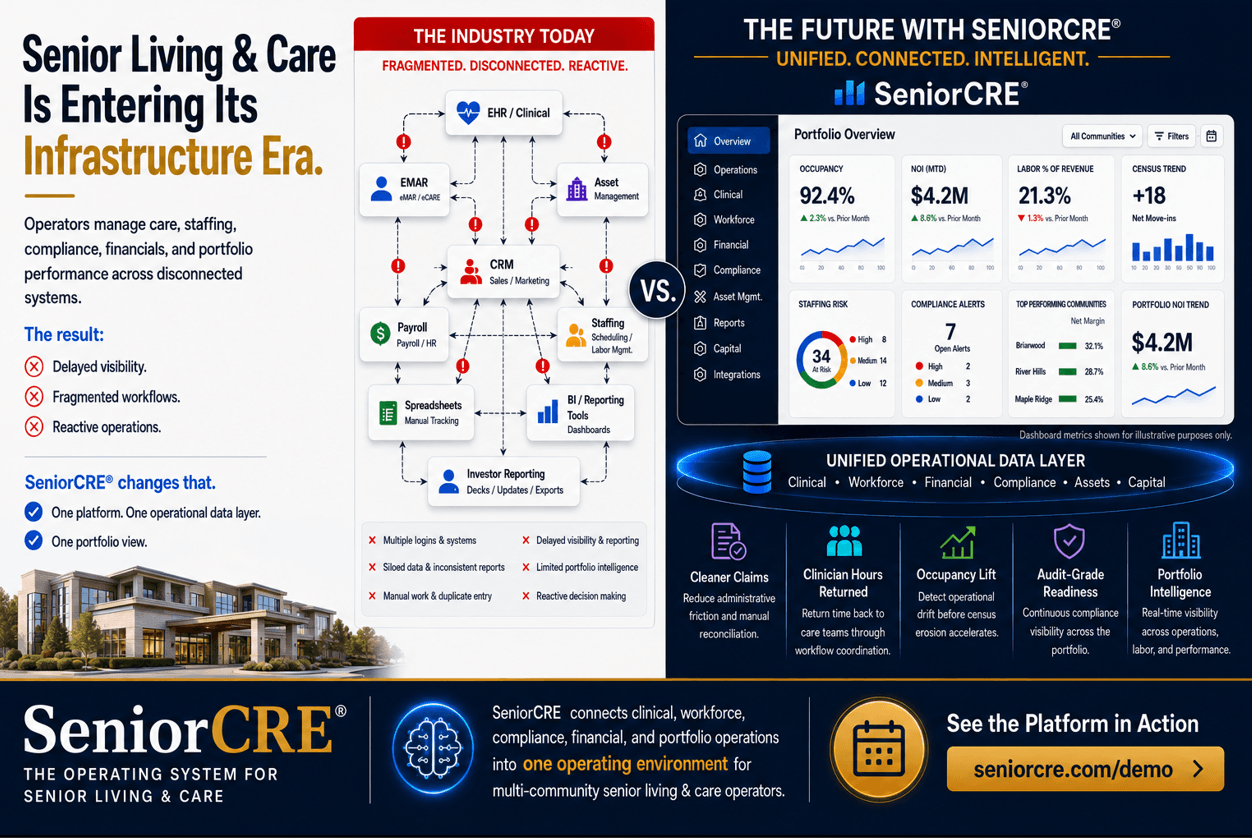
Senior Housing & Care is entering a new era. For decades, operators have been asked to manage increasingly complex businesses with systems that were never designed to work together. Clinical care lives in one platform. eMAR lives somewhere else. Payroll, staffing, CRM, BI, asset management, investor reporting, and spreadsheets all operate in separate lanes.
Each system may solve a narrow problem, but the operator is left managing the gaps.
The industry today: fragmented, disconnected, reactive
The problem is not that senior housing & care lacks software. The problem is that it has too much disconnected software. Every department has a tool. Every tool has a login. Every login creates another silo. Every silo slows down visibility, decision-making, and accountability.
The result is a fragmented operating environment where leadership often sees the problem after it has already become expensive:
- A census decline shows up after revenue is already down.
- Labor pressure appears after margins are already compressed.
- Compliance risk becomes visible after documentation is already incomplete.
- Investor questions arrive before the operator has clean portfolio-level reporting.
- Families, clinicians, executives, and ownership all work from different versions of the truth.
Disconnected systems create delayed visibility. Delayed visibility creates reactive operations. Reactive operations create margin pressure, compliance exposure, staff frustration, and investor uncertainty.
The future with SeniorCRE: unified, connected, intelligent
SeniorCRE changes the model. The future is not another point solution. The future is one connected operating environment where clinical, workforce, compliance, financial, asset, and capital data flow through one operator-controlled operating record.
Operators move from fragmented tools to one portfolio view — occupancy, NOI, labor as a percentage of revenue, census trends, staffing risk, compliance alerts, top-performing communities, and portfolio performance in one place.
This is not a prettier dashboard. It is a different operating model.
- When data is connected, operators can act earlier.
- When workflows are unified, teams can coordinate faster.
- When reporting is centralized, ownership gets cleaner visibility.
- When compliance is continuously visible, survey readiness becomes operational discipline instead of last-minute scrambling.
- When staffing, census, financials, and asset performance are connected, leadership can manage the business before small issues become enterprise problems.
The promise of SeniorCRE
Cleaner claims
Reduce administrative friction and manual reconciliation.
Clinician hours returned
Return time back to care teams through workflow coordination.
Occupancy lift
Detect operational drift before census erosion accelerates.
Audit-grade readiness
Continuous compliance visibility across the portfolio.
Portfolio intelligence
Real-time visibility across operations, labor, and performance.
The graphic tells a simple before-and-after story. Before SeniorCRE: operators manage care, staffing, compliance, finance, and portfolio performance across disconnected systems. After SeniorCRE: operators run the business through one Operating Infrastructure designed specifically for senior housing & care and care.
Why “infrastructure era” matters
Senior Housing & Care does not need more isolated software. It needs infrastructure — a connected operating layer that supports how modern operators actually run multi-community businesses: clinically, operationally, financially, and institutionally. SeniorCRE is built for that future.
- One platform.
- One operational data layer.
- One portfolio view.
- One operating environment for senior housing & care.
Explore the architecture in depth on the one operator-controlled operating record page, the clinical surface on the SeniorCRE Clinical Platform, the capital lens on the capital layer, and the full capability map in the 10 core operating capabilities of SeniorCRE.
Frequently asked questions
What does the “infrastructure era” of senior housing & care mean?
Senior Housing & Care no longer needs more isolated software — it needs infrastructure. The infrastructure era is the shift from disconnected point tools (EHR, eMAR, CRM, payroll, BI, asset management, investor reporting) to one connected operating environment that supports how modern multi-community operators actually run the business: clinically, operationally, financially, and institutionally.
Why is fragmentation the real issue, not lack of software?
Every department has a tool, every tool has a login, every login creates another silo, and every silo slows visibility, decision-making, and accountability. The problem is not that operators lack software — they have too much disconnected software. Fragmentation is what creates delayed visibility, reactive operations, margin pressure, compliance exposure, and investor uncertainty.
What changes when operators move to a unified operational data layer?
They move from fragmented tools to one portfolio view — occupancy, NOI, labor as a percentage of revenue, census trends, staffing risk, compliance alerts, top-performing communities, and portfolio performance in one place. When data is connected operators act earlier, when workflows are unified teams coordinate faster, when reporting is centralized ownership gets cleaner visibility, and when compliance is continuously visible survey readiness becomes operational discipline instead of last-minute scrambling.
Is SeniorCRE a dashboard or a different operating model?
A different operating model. The portfolio view is a byproduct of one operator-controlled operating record — six canonical entities (Resident, Care Plan, Ledger, Shift, Property/Unit, Entity) shared across clinical, financial, workforce, and capital workflows. The dashboard reconciles to the operating record because they are the same record.
Key Takeaways for Operators and Investors
- Disconnected systems create delayed visibility; delayed visibility creates reactive operations.
- Operator-controlled authority turns survey readiness into operational discipline, not last-minute scrambling.
- Senior Housing & Care needs infrastructure, not more isolated software.
These insights are derived from publicly available industry research and cited sources.
Get this article as a PDF
Save it for your team, share it with stakeholders, or read it offline. No email required.
Frequently Asked Questions
- What is the senior housing & care infrastructure era?
- The shift from disconnected point tools to governed operating infrastructure that supports clinical, operational, financial, and institutional workflows for multi-community operators.
- Why is fragmentation the real issue?
- Operators do not lack software — they have too much disconnected software. Fragmentation creates delayed visibility, reactive operations, margin pressure, compliance exposure, and investor uncertainty.
- Is SeniorCRE a dashboard or a different operating model?
- A different operating model. The portfolio view is a byproduct of governed definitions, authority, reconciliation, and lineage across clinical, financial, workforce, and capital workflows.