Forthcoming
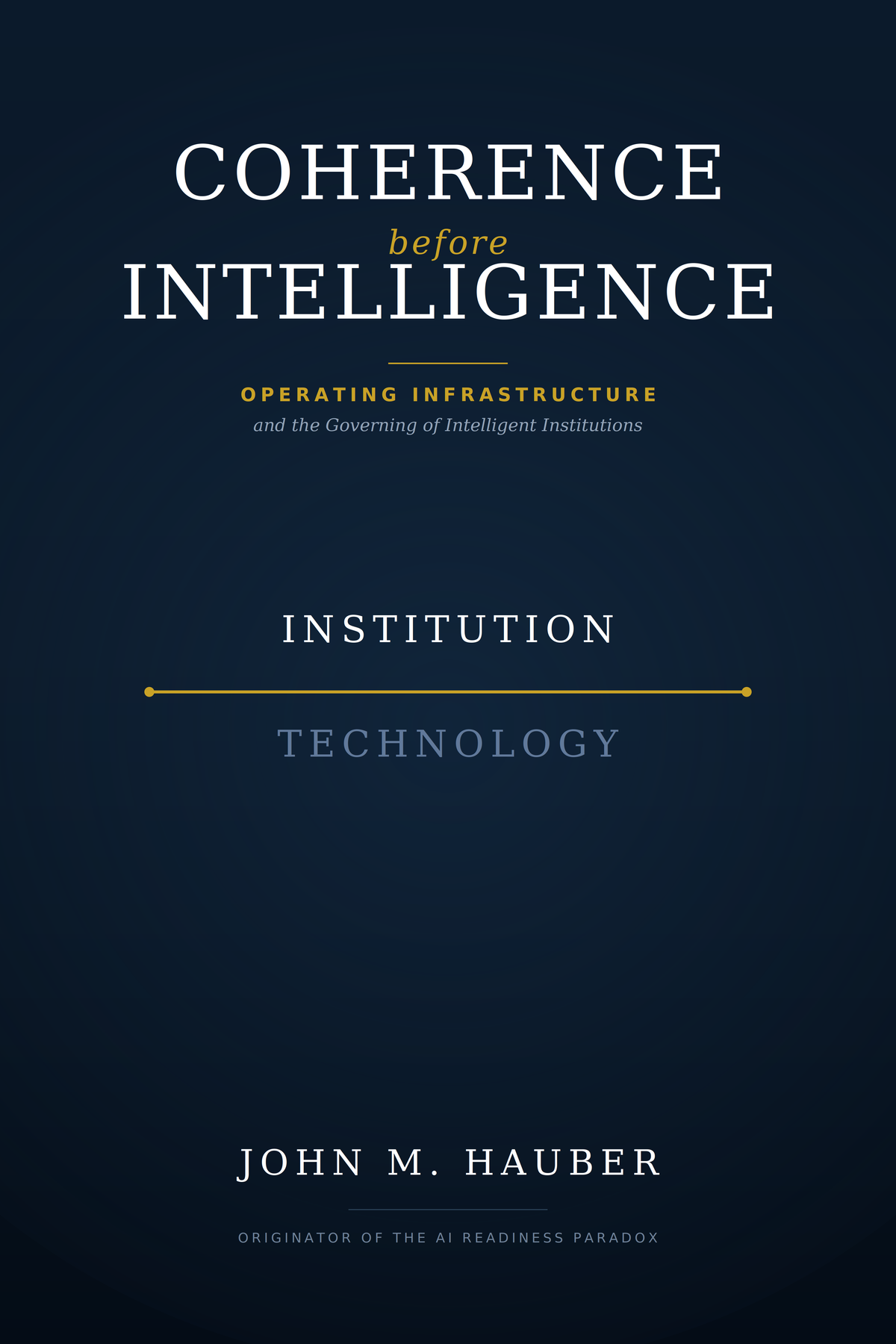
Operating Infrastructure and the Governing of Intelligent Institutions
John M. Hauber
Organizations do not become intelligent because they deploy artificial intelligence. They become intelligent because they learn to govern intelligence.
Listen
Listen to Coherence Before Intelligence on Spotify — the same argument, read aloud for the drive, the flight, or the walk between buildings.
Cross-industry follow-on · October 2026 preview
The authority deficit, three authority domains and six decisions that belong to leadership. A proposed framework—not deployed capability or independent validation.
Read the paper and six-decision frameworkThe Argument
Every generation of leaders inherits one management problem large enough to change how organizations are built. The Industrial Revolution required Scientific Management. The modern corporation required General Management. The Information Age required enterprise software.
The Intelligent Age requires something different: institutions capable of governing intelligence itself. Because artificial intelligence reasons from exactly the institutional environment we hand it. If enterprise truth is fragmented, AI reasons from fragmentation. If definitions conflict, it amplifies the conflict — faster, and with better formatting.
Artificial intelligence did not create this problem. It removed the padding that used to hide it.
The conditions that make artificial intelligence most valuable to an organization are the same conditions that make it least ready to govern it. Scale, specialization, and accumulated systems are why the investment case is compelling — and exactly what produce the fragmented truth AI amplifies.
Readiness declines as the case for adoption strengthens.
Most readiness assessments measure data volume, infrastructure maturity, and technical talent — all things a large, fragmented institution scores brilliantly on. Almost none measure whether the institution agrees with itself about what its numbers mean.
Every chapter ends with a Monday Morning exercise — the smallest real experiment that will show you the state of your own institution, usually within an hour.
The Manifesto
We believe institutions deserve governed truth.
We believe language is infrastructure.
We believe intelligence without governance creates fragility.
We believe artificial intelligence should elevate human judgment, not replace it.
We believe leadership is stewardship.
We believe every executive decision should leave the institution stronger.
We believe trust is an operational asset, not a sentiment.
We believe capability is more enduring than projects.
We believe the greatest competitive advantage of the Intelligent Age will be institutional coherence.
Coherence comes before intelligence, and the order is not negotiable.
Written for people accountable for an institution rather than a function — chief executives, boards, and the executives whose decisions touch more of the organization than they control. A health system COO, a university provost, a family business in its third generation, a founder crossing three hundred people, and a nonprofit director with a twenty-year mandate are all doing the same work under different names.
Twenty-four statements across six dimensions of institutional governance. Score them with your executive team — independently, before comparing. The variance between your leaders will tell you more than the total.

John M. Hauber has worked across commercial real estate, capital markets, healthcare, senior housing, operations, technology, and enterprise software. He is the originator of the AI Readiness Paradox and the author of the Operating Infrastructure discipline.
Disclosures. Coherence Before Intelligence is an independent work of the author. John M. Hauber is the founder of SeniorCRE and has a financial interest in it; readers should weigh that affiliation when reading passages that reference the platform.
This book and the materials on this page are provided for general informational and educational purposes only. They are not investment, legal, accounting, tax, regulatory, or clinical advice, are not an offer to sell or a solicitation to buy any security, and should not be relied on as a substitute for professional judgment or for the advice of licensed clinicians and counsel. No outcome, financial result, occupancy result, or compliance result is promised or implied.
The book describes an operating-infrastructure discipline, not a statement of operator-production maturity documentation. SeniorCRE is pre-production as of October 22, 2026; capability, certification, and roadmap status is published, dated, and maintained on the Trust Center. Forward-looking statements about roadmap, program economics, or timing are subject to change.
SeniorCRE is a registered trademark of SeniorCRE, LLC. Operator Authority Chain™ is a trademark of SeniorCRE, LLC. Other product and company names referenced in the book are trademarks of their respective owners and are used nominatively for identification and analysis only; no endorsement or affiliation is implied. Downloads are licensed for personal, non-commercial reading and may not be redistributed or resold.