
Governing Agentic SI in Senior Housing & Care
Illustrative framework · 2-page PDF · Design commitments, not demonstrated deployment.
Illustrative framework · 2-page PDF · Design commitments, not demonstrated deployment.
Why the industry’s AI transformation must begin with operator-controlled operating information—not another layer of intelligence.
By John Hauber | Founder & CEO, SeniorCRE® — November 17, 2026
Coherence before Intelligence.
The senior housing & care industry is approaching one of the most consequential technological transitions in its history.
Artificial intelligence promises to improve resident care, reduce administrative burdens, anticipate workforce challenges, strengthen financial performance and give leadership unprecedented visibility into complex operating environments.
These opportunities are real. But so is a fundamental danger that receives considerably less attention.
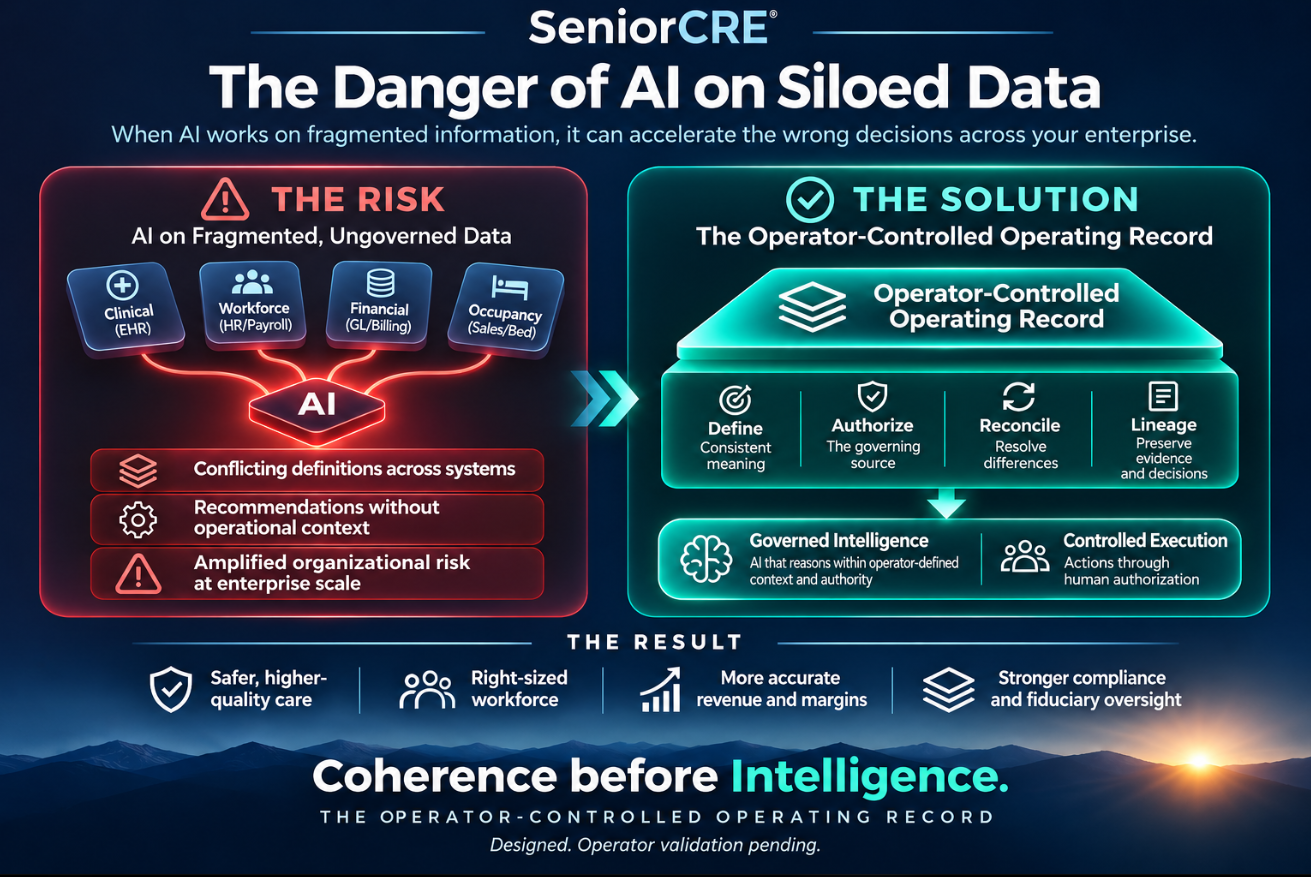
Artificial intelligence applied to fragmented, contradictory and ungoverned operating information can accelerate organizational mistakes faster than it improves organizational performance.
The risk is not simply that artificial intelligence may hallucinate.
It is that artificial intelligence may reason correctly from information that the organization itself has never reconciled or authorized for the decision being made.
That distinction should concern every CEO, CFO, COO, clinical leader, board member and institutional investor in senior housing & care.
In its November 16, 2026, article, 3 Steps to Take in Q4 2026 For AI Success in 2027, Senior Housing News explores how senior care organizations can prepare for practical artificial intelligence adoption.
The article highlights PointClickCare’s Chart Advisor and the potential for clinical intelligence to improve visibility into resident documentation, identify emerging risks and reduce manual review.
Its emphasis on focused operational objectives, information flows, measurable outcomes and human decision-making is constructive.
But there is a larger question facing multi-site senior housing & care organizations:
What happens when artificial intelligence needs to reason across the entire enterprise, rather than within a single application?
A clinical intelligence application may have meaningful visibility into resident documentation. A workforce intelligence application may understand staffing patterns. A financial intelligence application may identify changes in operating margins.
Each can provide value within its own domain.
However, resident care, workforce availability, revenue integrity, regulatory compliance and financial performance are not independent operating realities.
They are interconnected dimensions of the same enterprise.
When intelligence crosses those boundaries, the reliability of its recommendations depends on more than the quality of any individual system.
It depends on whether the organization has established a coherent, accountable representation of its operations.
Senior housing & care organizations are already rich in information.
A typical multi-site operator may depend on separate applications for:
Each system was designed to perform a particular function.
Each has its own definitions, reporting periods, data structures, workflows and assumptions.
And increasingly, each is acquiring its own artificial intelligence capabilities.
The industry risks moving from siloed operating systems to siloed artificial intelligence.
Instead of establishing a coherent enterprise, organizations could find themselves managing multiple intelligent systems that interpret different portions of the same operational reality.
The result may be more recommendations, more alerts, more predictions and more automated activity—without a corresponding improvement in organizational understanding.
Intelligence does not automatically create coherence.
Consider a fictional 120-unit senior living community preparing its September month-end owner report.
Four systems produce four different occupancy counts.
| Source system | Reported occupied units |
|---|---|
| Clinical census (EHR) | 101 |
| Billing ledger | 103 |
| Sales CRM | 102 |
| Bed board | 100 |
Which number should artificial intelligence use?
Which number should inform workforce forecasting?
Which number should be used to calculate operating performance?
Which number should be reported to the owner?
The differences may not represent software errors.
The clinical system may reflect residents physically in residence. The billing system may include departed residents still subject to contractual notice periods. The sales system may include future move-ins. The bed board may apply different rules to temporarily held units.
Each system may be functioning as designed.
Yet an artificial intelligence model without access to the operator’s governing definitions could select an inappropriate figure, combine incompatible measures or generate recommendations without recognizing the underlying disagreement.
A more advanced model might identify the discrepancy.
But identifying a discrepancy is not the same as possessing the authority to resolve it.
Model confidence never creates organizational authority.
Only the operator can determine which definition, source and reconciliation policy govern a particular business decision.
A clinical system may identify rising resident acuity while the scheduling system continues to allocate staffing based on historical census.
An intelligence application examining schedules alone could conclude that staffing levels are sufficient.
An application examining clinical documentation alone could identify increased care requirements without understanding whether the organization has the workforce capacity to meet them.
Neither necessarily possesses the complete decision context.
When clinical and workforce information cannot be reconciled, recommendations may overlook conditions that materially affect resident safety.
AI should support qualified clinical judgment, not substitute for it.
Artificial intelligence may identify labor costs that appear excessive relative to occupancy.
However, occupancy alone does not adequately represent care demand.
Higher resident acuity, one-to-one supervision, medication complexity, employee credentials and changing regulatory requirements may explain why additional staffing is necessary.
An optimization model without that context could recommend labor reductions precisely when the community requires additional resources.
What appears to be financial efficiency in one system may become operational risk in another.
A resident’s care requirements may increase without a corresponding update to the billing system.
A financial intelligence application may identify declining margins and recommend higher rates or expense reductions.
The underlying problem, however, could be a disconnect between documented care, assessments, contractual billing requirements and actual collections.
Without cross-system reconciliation, artificial intelligence may optimize the symptoms of a problem rather than identify its cause.
An AI-generated report can appear precise, professional and authoritative.
But when leadership must substantiate a consequential decision, presentation quality is irrelevant.
Executives need to demonstrate:
A model-generated recommendation without this evidentiary foundation can create additional accountability and compliance challenges.
The organization remains responsible for its decisions regardless of whether artificial intelligence contributed to them.
For REITs, private equity firms, owners and lenders, the consequences extend beyond individual communities.
If occupancy, labor productivity, revenue and NOI are calculated differently across a portfolio, artificial intelligence may compare communities that are not economically or operationally comparable.
Capital could be directed toward underperforming assets for the wrong reasons. Management performance could be mischaracterized. Forecasts and underwriting assumptions could reflect inconsistent definitions.
Portfolio-level intelligence is only as reliable as the operating information on which it depends.
Historically, fragmented information has created friction.
Executives reconcile spreadsheets. Department leaders investigate discrepancies. Finance teams challenge reports. Clinical leadership reviews exceptions. Regional operators request clarification before taking action.
These processes are inefficient, but they can also act as informal checks against consequential mistakes.
Artificial intelligence and autonomous agents introduce a different operating environment.
Recommendations can be generated continuously. Decisions can be proposed across hundreds of communities simultaneously. Workflows can be initiated without waiting for conventional reporting cycles.
The interval between information, interpretation and action is becoming shorter.
If governance does not advance at the same pace, organizations risk removing traditional safeguards without replacing them with stronger controls.
The danger increases as artificial intelligence progresses from answering questions to recommending decisions and initiating actions.
An incorrect spreadsheet can mislead a meeting. Ungoverned autonomous intelligence can propagate the same error throughout an enterprise.
Automation magnifies whatever foundation it is given.
A coherent foundation can support better decisions.
A fragmented foundation can amplify fragmentation.
Many organizations are attempting to address fragmentation through application programming interfaces, integration platforms, data warehouses, data lakes and business intelligence dashboards.
These technologies can play important roles.
They can make information more accessible, reduce duplication and improve visibility across applications.
But connectivity alone does not establish authority.
A data warehouse can contain four different occupancy figures.
A dashboard can display them.
An artificial intelligence model can interpret them.
None of those capabilities, by itself, establishes which figure the organization has authorized for its owner report.
There are three fundamentally different questions:
| Infrastructure | Question it must answer |
|---|---|
| Data integration | Can we access the information? |
| Artificial intelligence | What can we learn from the information? |
| Operating authority | What information are we authorized to rely upon for this decision? |
The third question is foundational to the other two when decisions carry enterprise consequences.
Organizations must distinguish between information availability and information authority.
SeniorCRE is being designed around a different architectural premise.
Before enterprise intelligence can reliably reason across senior housing & care operations, the operator must have a mechanism for establishing and governing the operating information on which that intelligence depends.
SeniorCRE calls this the Operator-Controlled Operating Record.
It is designed to establish a coherent, accountable operating representation across existing clinical, workforce, occupancy, financial, compliance and asset-management systems.
Its foundation consists of four essential disciplines.
The operator determines what each consequential operating measure means.
What constitutes occupied units? How is labor productivity calculated? When does a change in resident acuity become relevant to staffing or billing? What constitutes a comparable measure across communities?
Definitions belong to the organization, not to an artificial intelligence model.
The operator determines which sources, policies and individuals have authority for specific decisions.
A clinical system may govern a clinical observation, while the general ledger governs a financial posting.
Authority must be appropriate to the decision, rather than assigned universally to one application.
Conflicting information must be identified and evaluated against operator-defined rules.
Where policy resolves the discrepancy, the resulting calculation should be reproducible.
Where material uncertainty remains, the issue should be escalated to the appropriate authorized individual.
Unresolved disagreement must not be concealed merely to produce a convenient answer.
Governed operating information must retain its relationship to the underlying evidence.
Leadership should be able to understand what information was used, how it was interpreted, which rules applied and who authorized its use.
The objective is not simply a unified dashboard.
It is an operating record the organization can inspect, substantiate and govern.
SeniorCRE’s governing architecture is designed to establish a deliberate sequence between information and execution.
EVIDENCE → DISAGREEMENT → AUTHORITY → OPERATOR-CONTROLLED OPERATING RECORD → INTELLIGENCE → EXECUTION
Evidence: Preserve underlying source information, timestamps, definitions and provenance.
Disagreement: Identify material inconsistencies across systems.
Authority: Apply operator-defined policies, source authority and decision rights.
Operator-Controlled Operating Record: Establish the governed operating representation, including unresolved exceptions.
Intelligence: Enable authorized intelligence to reason within defined evidence and authority boundaries.
Execution: Permit action only through appropriate authorization, permissions and oversight.
This sequence changes the role of artificial intelligence.
Rather than allowing a model to implicitly determine what the organization should accept, the operator establishes the foundation on which intelligence is permitted to operate.
The artificial intelligence model becomes a consumer of governed operating context—not the originator of organizational authority.
AI can reason. The operator governs.
Responsible enterprise intelligence requires two distinct policies.
An AI system should operate with a clear understanding of which information is authoritative for the question being asked, which definitions govern and what material uncertainties remain.
If the evidence is insufficient or contradictory, the system should disclose that limitation and, when appropriate, request human adjudication.
The ability to identify an opportunity does not create permission to act on it.
An AI system may identify an apparent staffing inefficiency without having authority to modify a clinical staffing schedule.
It may identify a potential billing discrepancy without having authority to change a resident’s invoice.
It may identify a financial variance without having authority to alter the general ledger.
Interpretation, recommendation, approval and execution must remain distinct.
These boundaries become increasingly important as AI systems acquire more autonomous capabilities.
The long-term opportunity in senior housing & care is not merely to introduce more intelligent applications.
It is to enable intelligence to reason responsibly across the interconnected dimensions of the enterprise.
SeniorCRE’s proposed intelligence architecture includes four specialized systems:
Workforce Retention Intelligence Engine (WRIE)
Designed to investigate workforce instability, retention risks and potential intervention opportunities using authorized operating context.
Labor Cost Intelligence & Forecasting System (LCIFS)
Designed to support labor forecasting by examining relationships among staffing requirements, occupancy, acuity, overtime and agency utilization.
Physician Intent Intake & Execution Layer (PIIEL)
Designed to support accountable clinical workflows by connecting physician intent with appropriate authorization and execution controls.
Asset Lifecycle Intelligence & Replacement Planning (ALIRP)
Designed to inform capital allocation and asset replacement decisions within the broader financial and operational context of the portfolio.
These proposed capabilities share a common architectural premise.
Intelligence should not independently reconstruct the enterprise every time it encounters a new question.
It should be grounded in operating information whose definitions, authority, evidence and permitted uses have been established by the organization.
Senior housing & care organizations have made substantial investments in their existing clinical, financial and workforce systems.
Many of those applications perform their specialized functions well.
The emergence of artificial intelligence should not automatically require operators to abandon those investments.
SeniorCRE is designed to establish an operating authority layer across the systems an organization chooses to retain, while supporting deliberate replacement where the operator determines that replacement is appropriate.
Clinical systems can continue supporting care delivery.
Payroll systems can continue processing compensation.
Accounting systems can continue maintaining the general ledger.
Specialized artificial intelligence applications can continue delivering domain-specific value.
The architectural objective is to establish coherence across those environments without making any individual vendor the default authority over the entire enterprise.
Govern first. Replace only by choice.
Before authorizing enterprise-wide AI deployments, senior housing & care leadership should examine six questions.
| Executive question | Why it matters |
|---|---|
| Do our systems agree on fundamental operating measures? | Reveals underlying fragmentation. |
| Have we established consistent definitions? | Prevents incompatible comparisons. |
| Who determines which source governs each decision? | Preserves organizational authority. |
| Can AI distinguish governed information from unresolved disagreement? | Prevents unsupported recommendations. |
| Can we reconstruct the evidence behind an AI-assisted decision? | Strengthens accountability. |
| Who controls what artificial intelligence is permitted to execute? | Protects against unauthorized action. |
An organization that cannot answer these questions should not necessarily abandon artificial intelligence.
It should establish the missing infrastructure while pursuing carefully bounded, measurable and appropriately supervised AI initiatives.
The Senior Housing News article provides a useful starting point for adopting intelligence within defined operational workflows.
SeniorCRE proposes an additional step for operators preparing for the next generation of enterprise AI:
Establish operator-controlled operating authority before scaling intelligence across the enterprise.
Start with one consequential measure.
Occupancy is an appropriate candidate because it affects financial performance, workforce planning, revenue forecasting, owner reporting and institutional capital decisions.
Identify how existing systems calculate it.
Document the differences.
Establish the governing definition.
Determine which evidence is authoritative.
Identify who has approval authority.
Preserve the reasoning behind the final reporting figure.
Then establish what artificial intelligence may infer from that information and what actions it may recommend or initiate.
This is a bounded way to begin developing the institutional discipline necessary for governed enterprise intelligence.
The artificial intelligence models available to senior housing & care organizations will continue to improve.
Processing costs may decline. Context windows may expand. Reasoning capabilities may become more advanced. Autonomous workflows may become more sophisticated.
But access to better artificial intelligence will not necessarily differentiate one operator from another.
What may differentiate organizations is their ability to establish coherent, trusted, accountable and actionable operating information.
The organizations best positioned to benefit from artificial intelligence may be those that can answer three fundamental questions:
What do we know?
What are we authorized to rely upon?
What are we authorized to do about it?
These are not exclusively technology questions.
They are questions of institutional governance.
The future of senior housing & care should not be an enterprise populated by independent artificial intelligence applications, each interpreting a different version of its operations.
It should be an enterprise in which intelligence operates from a coherent foundation, reflects the operator’s governing policies, supports accountable human judgment and contributes to better outcomes for residents, employees and capital partners.
Artificial intelligence is a powerful capability.
But intelligence without coherence can become a powerful liability.
SeniorCRE is being designed to establish the operating infrastructure necessary to address this challenge.
Not by replacing human authority.
Not by assuming every existing system must be replaced.
And not by allowing artificial intelligence to decide which operating information the organization should accept.
Instead, by establishing the operator’s authority over the information that intelligence is permitted to use.
When systems disagree, the operator governs.
Coherence before Intelligence.
Bring one consequential operating number your systems disagree on.
In a 30-minute executive assessment, we will examine the underlying definitions, source authority, evidence and decision rights necessary to establish an accountable reporting figure.
No resident data is required for the initial conversation.
SeniorCRE is the operator-controlled operating infrastructure being developed for senior housing & care. Its architecture is designed to establish operator-defined definitions, source authority, reconciliation and lineage across existing operating systems, creating the foundation for governed enterprise intelligence.
Architecture and evidence disclosure: SeniorCRE’s Operator-Controlled Operating Record and specialized intelligence systems represent published architecture and design intent. Real-world operator validation remains pending. The occupancy example in this article is illustrative and does not represent a customer outcome. Governance infrastructure is a necessary foundation for responsible enterprise AI, but does not independently eliminate model, clinical, cybersecurity or operational risks.
These insights are derived from publicly available industry research and cited sources.
Save it for your team, share it with stakeholders, or read it offline. No email required.