
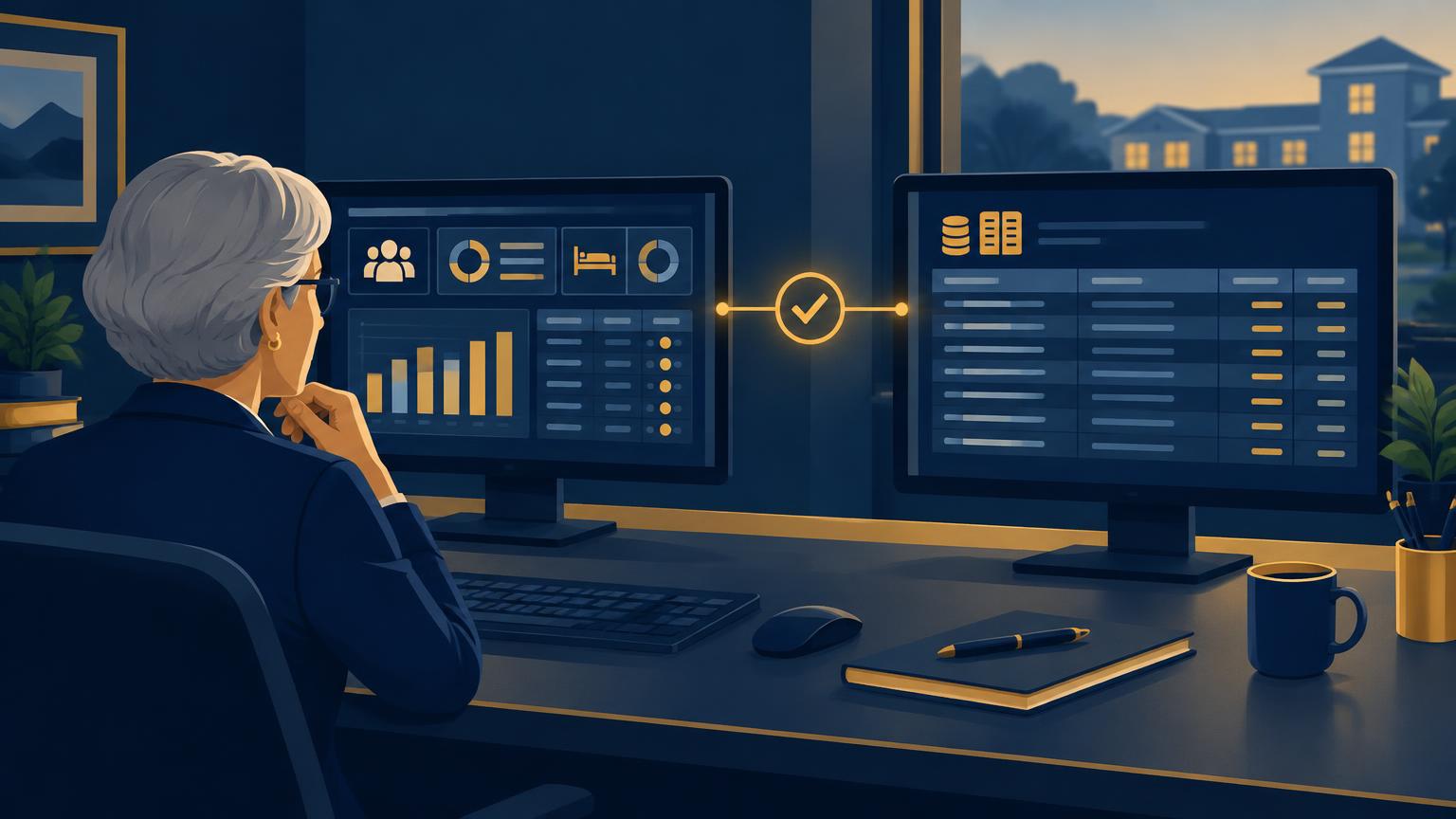
In most senior housing & care portfolios, reconciliation is where operating reality meets the general ledger — manually. Census says one number, billing says another, the accounting system records a third, and a finance analyst spends days each month in a spreadsheet deciding which one the organization will believe. The work is repetitive, the errors are expensive, and the close slips while people argue about whose extract was current.
Automating that reconciliation is a reasonable goal. The risk is doing it in a way that obscures errors instead of surfacing them: a system that silently picks a value, overwrites the sources and leaves no trail has automated the labor and destroyed the control. This guide walks through the sequence that avoids that outcome — standardized definitions first, then connectivity, matching, exception routing and human approval — and the questions to ask any vendor, including us, before you commit.
01Standardize the definitions before you connect anything
Most reconciliation pain is not a matching problem — it is a definition problem. "Occupied units" means something different to the clinical census (who is physically in residence), the billing ledger (who is being charged), the sales CRM (who has signed) and the bed board (which units show as taken). All four can be correct and still disagree.
Before any automation, write down the canonical definition of each reconciled field, its intended use, and which system is the authority for which purpose. Occupancy for revenue recognition may follow the billing ledger; occupancy for a lender report may follow an operator-approved operating definition. If you skip this step, automation will simply produce the wrong answer faster and more consistently.
02Connect the systems you already run
You should not have to replace your accounting, billing or resident management systems to reconcile them. A reconciliation layer reads from each system of record — through whatever interface each vendor supports — and preserves the original values exactly as asserted. Replacement is a separate decision; reconciliation should not depend on it.
Ask each vendor to demonstrate connectivity against your actual systems and versions, not a reference environment. The question is not "do you integrate with X" but "show me a representative month of our transactions moving from our billing system into your reconciliation view, with the source values intact."
03Automate the matching, not the judgment
Once definitions and connections exist, software can do what people should never have done by hand: match every operating record to its accounting entry, at line level, every night. Resident-level charges to ledger postings, move-ins to billing start dates, care-level changes to rate changes. The matched majority — often the large majority of transactions — clears without human attention.
The rule that protects control: automated matching may clear agreements, but it must never resolve disagreements. Where two sources conflict, the system records both values and routes the difference. It does not average, overwrite or pick the most recent.
04Configure reconciliation rules the operator owns
Matching rules are business policy, not vendor defaults. Tolerances (a one-day billing lag is expected; a one-month lag is not), authority order (which system wins for which field and purpose), and timing conventions (month-end cutoff, proration) should be configured, reviewed and versioned by your finance leadership — and changeable by them without a vendor ticket.
Every rule change should itself be logged: who changed it, when, from what to what, and why. A reconciliation rule that can change silently is a control weakness, not a convenience.
05Route exceptions to humans, with the evidence attached
The output of automated reconciliation is not a report — it is a work queue. Each exception should arrive with both source values, the rule that flagged it, the definition at issue and the history of the record, so the reviewer decides from evidence instead of re-running the investigation the system already did.
This is the answer to the legitimate CFO concern that automation obscures errors: done correctly, it does the opposite. Errors that today hide in spreadsheet tabs become named, routed, time-stamped exceptions with an accountable owner.
06Keep human approval on the record that governs
The reconciled figure that enters management reporting or the close should carry a named human approval — the reviewer, the evidence they saw, the rule applied and the time. Software proposes; a person disposes. That approval record is what lets you show an auditor, lender or board not just the number, but why the number is the number.
Approval should be purpose-specific. The same disputed field may resolve differently for revenue recognition than for an operating dashboard, and the record should show which approval covers which use.
07Preserve lineage from source to statement
Every figure in a financial report should be traceable back through the reconciliation decision, the rule version, the approval and the original source assertions — without a archaeology project. When an auditor or a lender asks "where did this occupancy figure come from," the answer should be a record, not a search.
Lineage is also what makes the system safe to scale. When the tenth community comes online, its reconciliation inherits the same definitions, rules and evidence structure rather than a tenth spreadsheet variant.
08Scale across the portfolio without multiplying the work
The portfolio test: adding a community should add its transactions to the same reconciliation, not add a reconciliation. Shared definitions, shared rules, community-level exceptions. If each community reconciles differently, you have automated ten silos instead of one process.
Measure the result honestly: hours of matching labor per close, days to close, exceptions per hundred transactions, and the share of figures in board reporting that carry a traceable approval. Those four numbers tell you whether the automation worked.
A worked example on synthetic data
Illustrative example on synthetic data — not an operator result. A 120-unit community at month-end: the clinical census shows 101 occupied units, the billing ledger 103, the sales CRM 102 and the bed board 100. Under the operator's approved rules, revenue recognition follows the billing ledger, so 103 governs the revenue report. But the reconciliation does not stop there: the two-unit gap between census and billing is routed as an exception.
The reviewer opens the exception and sees the evidence side by side: one resident discharged on the 28th whose final charges post the following month, and one respite stay billed but never entered in the clinical census. Both are resolved, both resolutions are recorded with the reviewer's approval, and next month the same rule catches the same pattern automatically. The residual after reconciliation is zero — and the record can show why.
Questions CFOs ask next
Which software platforms automate reconciliation between senior living operating and accounting systems?
A small number of platforms address pieces of this: accounting suites with bank-level reconciliation, integration tools that move data between systems, and operating platforms that standardize definitions. The differentiating questions are whether matching happens at line level against your actual operating systems, whether exceptions route to humans with evidence attached, and whether the reconciled record carries a named approval and full lineage. SeniorCRE's Operator-Controlled Operating Record is designed around exactly those requirements; it is designed and not yet implemented in any community, and we make the same evidence demands of ourselves that this guide makes of any vendor.
Can reconciliation software connect to our existing accounting, billing and resident management systems?
It should — that is the baseline requirement. Replacing working systems to reconcile them is rarely justified. Ask for a demonstration against your actual systems and versions, with your representative transactions, and ask which interfaces are live integrations versus roadmap items. For SeniorCRE specifically: named integrations are roadmap items, not built; our current posture is to govern what your existing systems produce, with connectivity validated per deployment.
How much does automated reconciliation software cost for a senior living portfolio?
Pricing models vary widely — per community, per unit, per transaction or flat platform fees — and published figures are rarely comparable because they bundle different scopes. The more useful exercise is the cost of the status quo: analyst hours per close, days of close delay, error rework, and the audit and lender friction of untraceable figures. Our Executive Operating Economics Model lets you run that comparison with your own numbers and editable, clearly labeled illustrative assumptions.
What implementation effort and internal resources would our finance team need?
The honest answer: the heavy lift is definitional, not technical. Expect your finance leadership to spend real time in the first weeks agreeing canonical definitions, authority order and tolerances — the work in steps 1 and 4. After that, the ongoing burden should be exception review, not matching. Any vendor who tells you there is no internal effort is describing a system that will encode someone else's definitions into your close.
Can vendors demonstrate exception handling, approval controls and audit trails using representative transactions?
They should be able to, and you should insist on it before any commitment. Bring a real (anonymized) disputed month and watch the vendor walk it: both source values preserved, the exception routed, the evidence attached, the approval recorded, the lineage retrievable. If the demonstration silently resolves the disagreement, you have learned the most important thing about the product.
How can we measure the return on investment from reduced reconciliation work and faster financial close?
Baseline four numbers before you start: matching hours per close, days to close, exceptions per hundred transactions, and the share of reported figures carrying a traceable approval. Re-measure at 90 and 180 days. Treat projected savings as hypotheses until your own baselines confirm them — including any projections from us.
Where SeniorCRE stands
The Operator-Controlled Operating Record is designed and not yet implemented in any community. Nothing in this guide is a claim of deployed reconciliation, live accounting integrations or measured operator outcomes. Product acceptance requires function-specific implementation, testing and operator approval; current assurance and readiness information lives in the Trust Center. The seven-step reconciliation method with worked examples is on our CFO page, and the occupancy example is developed further in The Value of Operator-Controlled Truth.
Bring one disputed month to the conversation
The fastest way to evaluate this approach is against your own reconciliation: one community, one month, one disputed field.
Request an Executive Briefing