
The value of operator-controlled truth
Your systems can disagree. Your organization still needs one decision it can defend.
SeniorCRE is designing an Operator-Controlled Operating Record that establishes which information governs enterprise decisions—and a SeniorCRE Intelligence Layer designed to reason from that authorized record.
Coherence Before Intelligence.
Architecture and intended outcomes shown. No operator-production deployment or validated operating outcomes claimed.
The problem is not always bad data. It is competing valid definitions.
Census, clinical, accounting, workforce and CRM systems can each be correct for their own purpose. An enterprise decision still needs an authorized definition. Matching duplicate identities—the same resident or unit in two systems—is a different problem from choosing which valid business definition governs a particular decision.
Hypothetical illustration — not customer data
- Clinical / operational occupancy
- 91.7%
- Valid for: Staffing and care planning
- Hypothetical illustration
- Revenue occupancy
- 89.9%
- Valid for: Billing and financial reporting
- Hypothetical illustration
- CRM pipeline / inventory occupancy
- 92.1%
- Valid for: Sales and move-in planning
- Hypothetical illustration
Each figure can remain legitimate for its own decision. The question is not which number is “right.”
Which definition is authorized to govern this specific decision, entity, period, and audience?
Proposed operating architecture
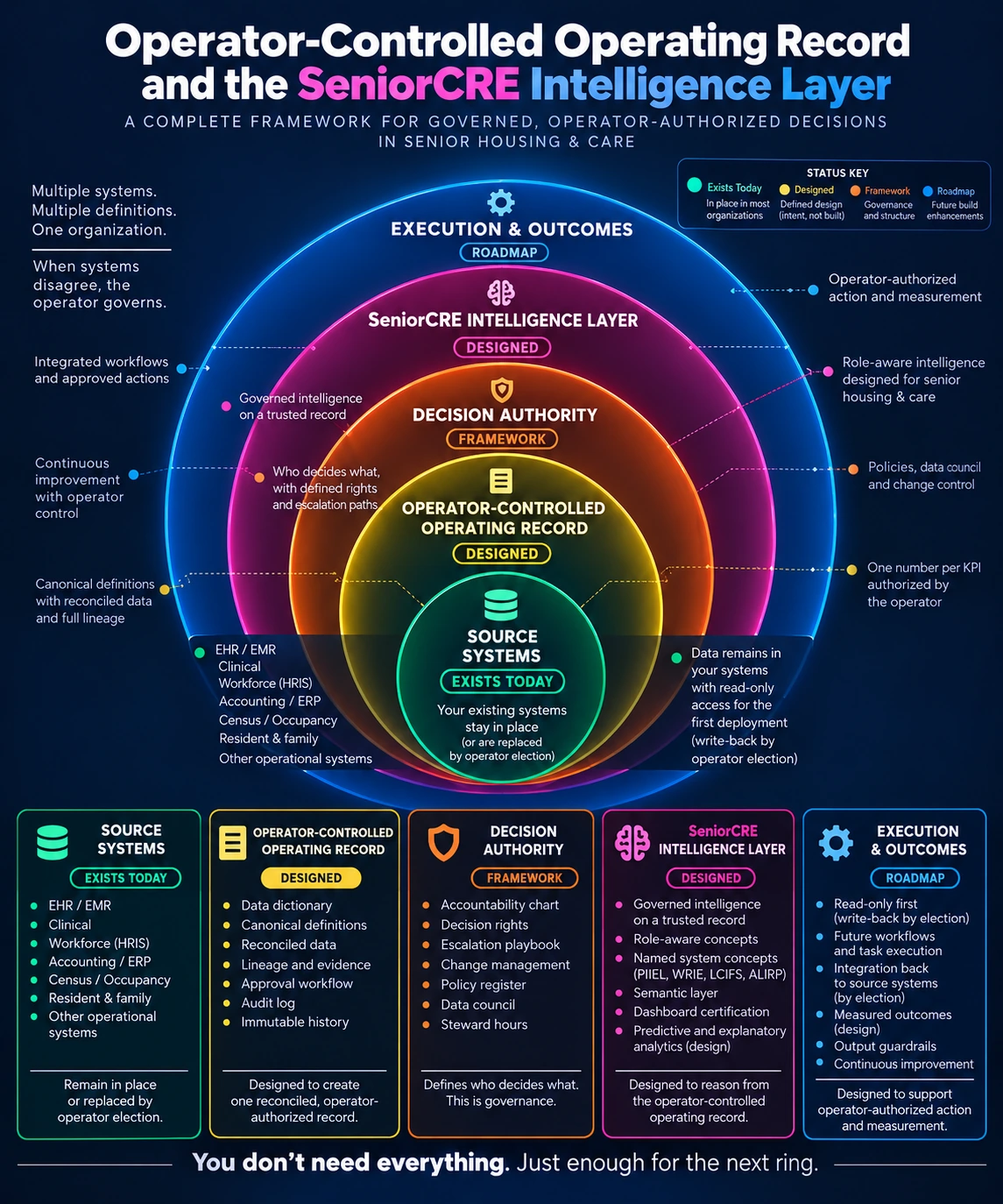
Five rings, from the systems you run to the outcomes still to be proven
Select or tab to a ring to read its meaning, intended functions, status and the evidence it needs to graduate.
- Existing systems — Software the operator already runs; not a SeniorCRE capability.
- Framework — Roles and policies the operator’s organization defines and assigns.
- Designed — Specified by SeniorCRE; not deployed or validated with an operator.
- Roadmap — Future work that requires separate operator election and authorization.
DESIGNED / NOT OPERATOR-VALIDATED
Operator-Controlled Operating Record
The proposed record of which definition governs a decision, which source holds authority, how disagreement is reconciled and where each figure came from, with competing source evidence preserved rather than overwritten.
Intended functions
- Definition
- Source authority
- Reconciliation
- Lineage
- Preserved competing evidence
Evidence required to graduate
A demonstrated reconciliation of a real disagreement with lineage and adjudication an operator accepts.
Text description of all five rings
- Source Systems (EXISTING SYSTEMS). The clinical, workforce, accounting, census and CRM systems an operator already runs. Each can be correct for its own purpose. By the operator’s choice, this ring can also be SeniorCRE itself: the SeniorCRE Operator Module can serve as the system of record for selected functions, alongside or in place of an existing system. Deployment is always the operator’s decision. The Operator Module has no operator-production deployment, and some functions, including native eMAR, are roadmap and not built. Graduation evidence: Operator-authorized, read-only access to the specific sources a pilot needs — or, where the operator chooses the Operator Module as system of record for a function, operator acceptance of that function before it governs.
- Operator-Controlled Operating Record (DESIGNED / NOT OPERATOR-VALIDATED). The proposed record of which definition governs a decision, which source holds authority, how disagreement is reconciled and where each figure came from, with competing source evidence preserved rather than overwritten. Graduation evidence: A demonstrated reconciliation of a real disagreement with lineage and adjudication an operator accepts.
- Decision Authority (OPERATOR GOVERNANCE FRAMEWORK). The people and policies the operator assigns: who owns a definition, who may approve it, how disputes escalate and who adjudicates. These are organizational roles, not product features. Graduation evidence: Named operator roles assigned, accepted and exercised on at least one governed decision.
- SeniorCRE Intelligence Layer (DESIGNED / NOT OPERATOR-VALIDATED). Intended role-aware intelligence that reasons only from operator-authorized context, within permission and traceability boundaries. Model confidence never creates organizational authority. No deployed or independently verified agents are claimed. Graduation evidence: Validated model-boundary and permission controls against an accepted record.
- Execution and Measurable Outcomes (ROADMAP / TO BE PROVEN). A read-only pilot comes first. Any write-back, integration or controlled execution would follow only after separate operator election, acceptance gates and explicit authorization. No outcomes are measured today. Graduation evidence: Separate authorization, then outcomes measured against a pilot baseline.
The rings describe a proposed operating architecture—not a claim that each layer has been deployed.
You don’t need everything. Just enough for the next proof gate.
Two roads. The choice is the operator’s.
Road 1
Keep your existing systems.
SeniorCRE is designed to govern cross-system definitions and accepted decisions above the incumbent stack, starting read-only.
Road 2
Replace only by choice.
An operator may separately elect SeniorCRE for selected system-of-record domains under a distinct procurement, migration, validation and acceptance decision.
Neither road is implemented in operator production today. No forced replacement and no guaranteed compatibility with every vendor are implied.
Potential value; subject to validation with an operator
What each decision-maker could gain
CEO
Enterprise consistency and accountability across communities.
Potential value; subject to validation with an operator
CFO
Defensible occupancy, revenue and labor definitions, with report lineage and fewer unexplained variances.
Potential value; subject to validation with an operator
COO
Clearer escalation and reconciliation ownership, and more reliable multi-site comparisons.
Potential value; subject to validation with an operator
Institutional owner / REIT
A consistent reporting standard and more intelligible operator evidence, while the operator retains authority over its own definitions and systems.
Potential value; subject to validation with an operator
Clinical leadership
Appropriately scoped future intelligence grounded in accepted facts, privacy and permission rules.
Potential value; subject to validation with an operator
Related reading: The Institutional Operator · The Institutional Owner · SeniorCRE AI
The first proof: one occupancy number
Acceptance objectives to be tested—not accomplishments.
- 1Obtain authorized read-only sources and map distinct occupancy definitions.
- 2Reproduce a real cross-system occupancy disagreement without losing original source evidence.
- 3Capture operator approval of the definition and context governing one chosen decision.
- 4Produce a reconstructable report with source lineage, authority, period and approval.
- 5Evaluate reconciliation effort, reporting acceptability, user confidence, workflow acceptance, security and willingness to pay.
Pilot outcomes pending; none claimed today.
What is the framework—and what is proven?
Status reviewed .
Source systems
EXISTING OPERATOR INFRASTRUCTURE
Proposing: Incumbent software exists and remains the operator’s.
Evidence still required: Access and integration eligibility are operator-specific.
Operator governance
FRAMEWORK
Proposing: Humans, policies and roles defined by the organization.
Evidence still required: Assignment and acceptance to be tested.
Operator-Controlled Operating Record
DESIGNED
Proposing: Definitions, authority, reconciliation and lineage for governed decisions.
Evidence still required: No operator-production deployment; reconciliation, lineage and adjudication demonstration still required.
SeniorCRE Intelligence Layer
DESIGNED
Proposing: Role-aware intelligence bounded by operator authorization.
Evidence still required: No deployed, validated role-aware agents are asserted; model-boundary controls must be validated.
Execution / outcomes
ROADMAP
Proposing: Read-only first; future write-back only by operator choice and separate approvals.
Evidence still required: No measured outcomes.
Status is specific to this public framework; other controlled-environment capability claims on the site do not equal validated operator deployment.
Illustrative, not promised
Why this could become enterprise infrastructure.
Operating reviews, ownership reporting, portfolio allocation, covenant packages and capital decisions all depend on figures that someone can stand behind. Where definitions are authorized and comparable, those conversations could rest on shared ground rather than competing spreadsheets. No savings, returns or cost reductions are claimed; any economic effect is to be measured during a pilot.
Start with one decision your organization needs to defend.
The first conversation is not about replacing your systems or buying a full AI stack. It is about identifying a consequential metric, finding where valid definitions disagree, and determining what evidence and operator authorization a governed record would require.
Architecture under validation. No operator-production outcomes represented.