
Workforce & Labor
How can operators connect staffing decisions to governed census?
Last reviewed
Direct answer
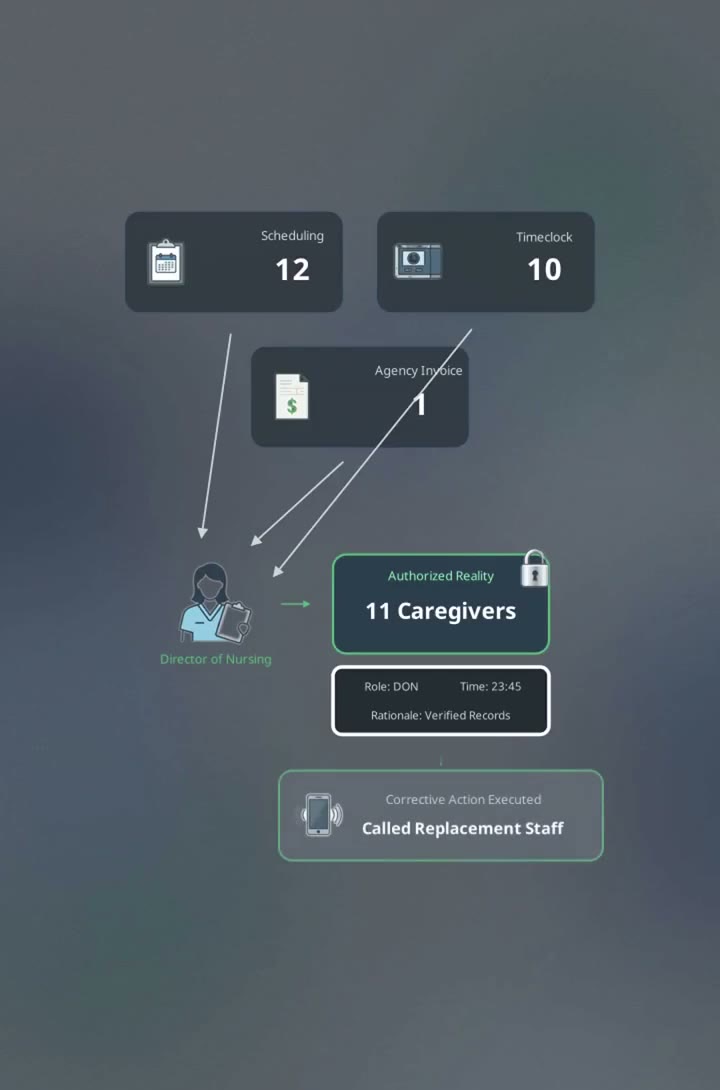
Make the governed staffing census the input staffing decisions actually read. Update it as admissions, discharges and leave happen, show it next to scheduled hours, and record staffing decisions against it. The connection breaks when schedulers work from a census report pulled at a different time or from a different source.
Videos that answer this question


Why this happens
Schedulers often keep their own census list because the official one is late or unclear.
Recording decisions against a governed census makes later review of staffing adequacy fair to the people who made them.
Hypothetical example: labor hours per resident day
Payroll hours ÷ EHR census
3.9
Uses the clinical census, which includes a bed hold.
Payroll hours ÷ billed days
4.1
Uses accounting’s billable days.
Scheduled hours ÷ budget census
3.6
Uses planned hours against a budget assumption.
- Evidence
- Disagreement
- Authority
- Operator-Controlled Operating Record
- Intelligence
- Execution
Illustrative figures. Coherence before Intelligence.
All three ratios are arithmetically correct. They answer different questions, and a portfolio comparison is only meaningful if every community uses the same governed definition.
The governance question
Staffing decisions should read from a census the operator has approved for staffing, and labor KPIs should declare which hours and which census they use. Agency, overtime and pickups need explicit treatment rather than being absorbed silently.
Evidence → Disagreement → Authority → Operator-Controlled Operating Record → SeniorCRE Intelligence → Execution
What good operating infrastructure should do
- An approved staffing census and labor definitions.
- Reconciliation between scheduled, worked and paid hours.
- Explicit treatment of agency, overtime and premium pay.
- Comparable labor KPIs across communities.
- Timely updates when census changes quickly.
SeniorCRE perspective
SeniorCRE is designed to tie labor measures to a governed census so staffing, finance and leadership read the same denominator. Workforce systems stay authoritative for hours and pay; the operator governs how they combine with census into a decision. Status: the Operator-Controlled Operating Record is designed and not yet implemented in any community. Current capability states and production-entry gates are published in the Evidence Record at the Trust Center; nothing here should be read as a production result.