
The senior housing & care industry is entering a new phase of enterprise technology. For years, operators have invested in electronic health records, workforce management platforms, accounting applications, customer relationship management systems and business intelligence tools. Each investment addressed an important operational requirement.
But collectively, these systems created a new challenge: organizations now operate across multiple technologies that may produce different answers to the same business question. Discovery Senior Living is taking meaningful steps to address that challenge. Recent industry reporting describes how one of the nation’s largest senior living operators is developing enterprise data infrastructure to consolidate information, standardize business terminology and support more consistent operational decision-making.
The significance extends well beyond Discovery. It suggests that the next competitive advantage in senior housing & care may come not from collecting more information, but from establishing a consistent operating understanding across the enterprise. And that raises an important question: once an organization brings its information together, who determines what the information actually means?
Discovery Senior Living is addressing a fundamental industry problem
According to industry reporting published October 26, Discovery Senior Living is now the nation’s largest senior living operator; earlier 2026 reporting describes a portfolio of more than 420 communities across 40 states. Its enterprise technology initiative includes consolidating information from numerous operational platforms—22, according to April reporting—into a shared data environment.
The effort reportedly incorporates Snowflake infrastructure, a multistage data-cleansing process and standardized business terminology across community operations. Information from financial, clinical, resident engagement and other operating systems can increasingly support a more comprehensive view of enterprise performance.
The initiative also addresses an important consideration for rapidly expanding operators: acquired communities may operate on different technology platforms. Rather than requiring immediate replacement of every existing system, an enterprise data architecture can help organizations bring information together while preserving operational continuity.
Discovery CEO Richard Hutchinson has connected stronger information infrastructure with institutional partner expectations and more effective operational decision-making. This represents a significant direction for the industry. It also highlights a reality many senior housing executives already recognize: enterprise growth increases the importance of consistent information—and exposes the limitations of fragmented operating systems.
Institutional capital is changing the information requirements of senior housing
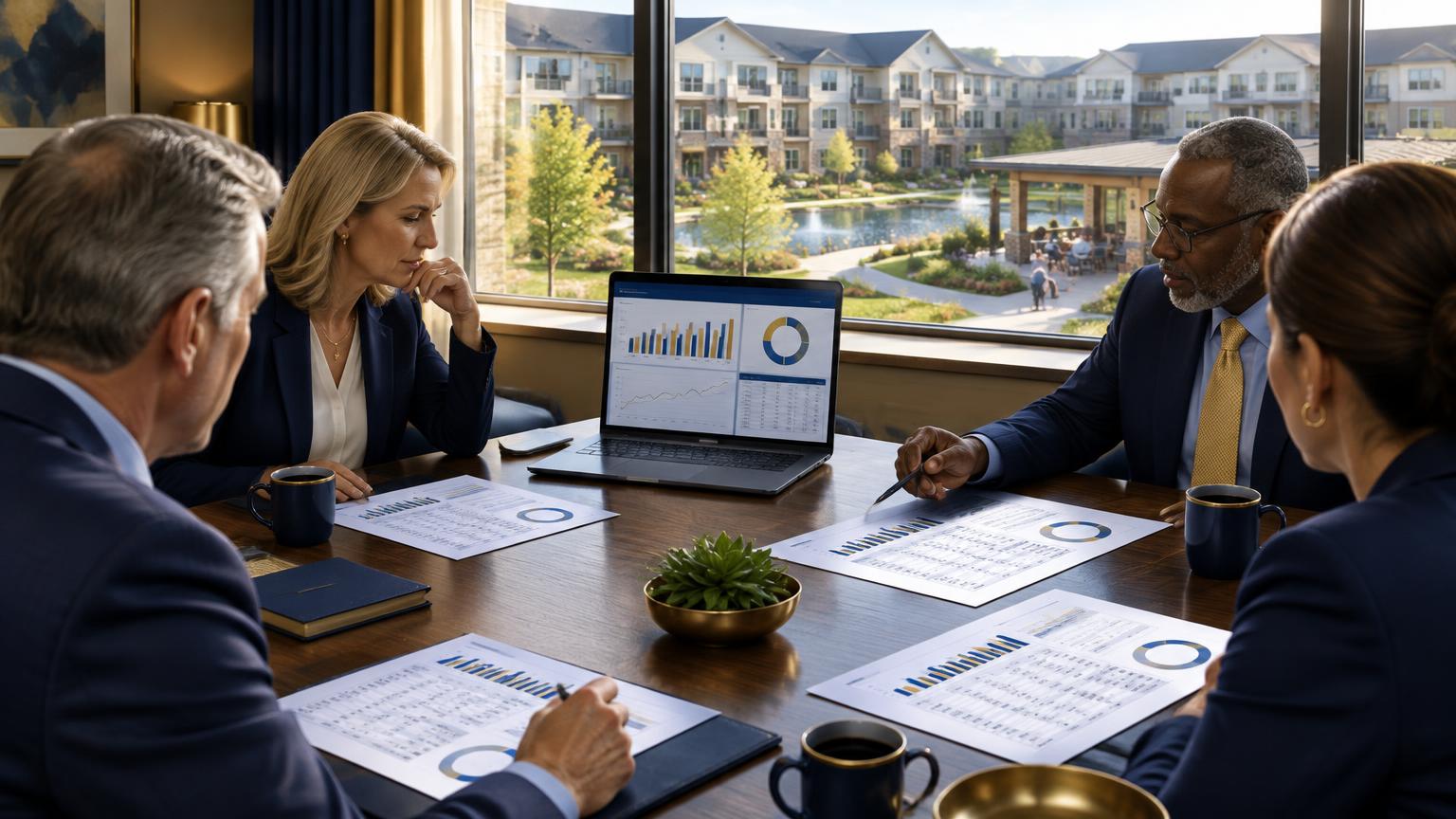
Senior housing is becoming increasingly institutional. Real estate investment trusts, institutional investors, private equity sponsors and sophisticated ownership groups are placing greater emphasis on portfolio performance, operating consistency and management accountability. Owners increasingly need reliable answers about occupancy, revenue performance, labor utilization, resident acuity, operating margins and community-level performance.
Consider a common, illustrative situation. An operator manages 30 communities across several states. Occupancy comes from a resident management system. Revenue comes from accounting. Move-in and move-out activity is tracked through operational workflows. Sales teams maintain additional information in a CRM. Each system may report a different occupancy figure—often for legitimate reasons: definitions, reporting periods, inclusion rules or transaction timing.
Which figure should the CEO use? Which should the CFO certify? Which should be provided to the institutional owner? And which should an AI system use when evaluating portfolio performance? These are not simply questions about technology integration. They are questions about organizational authority.
Bringing data together is essential. It is not the final step.
Enterprise data platforms can consolidate information from multiple applications, standardize terminology, improve reporting consistency and support sophisticated analytics. For many organizations, these capabilities represent substantial progress. But combining information does not automatically resolve disagreements between legitimate sources.
Consider occupancy in a hypothetical example. One system reports 91.2%. Another reports 89.7%. A third reports 90.4%. All three may be correct according to their own definitions. A data warehouse can store all three. A business intelligence application can display all three. An AI assistant can explain why they differ.
One decision remains: which definition and resulting value has the organization authorized for a particular business purpose? That requires more than data cleansing. It requires defined business meaning, evidence, accountability, decision rights and a record of the authorized determination. This is the distinction between standardized information and an Operator-Controlled Operating Record.
The next layer: the Operator-Controlled Operating Record
At SeniorCRE, our architectural thesis begins with a principle: Coherence before Intelligence. Before artificial intelligence can reliably support consequential operating decisions, an organization needs a coherent understanding of the information on which those decisions depend.
That does not mean every application must contain identical information, nor that every source system must be replaced. It means the operator must be able to establish which information governs a particular decision—and preserve the evidence supporting that determination. SeniorCRE is developing an Operator-Controlled Operating Record designed to support this process across independent operating systems.
The intended sequence: Evidence → Disagreement → Authority → Operating record → Intelligence → Execution. First, preserve the underlying evidence from existing systems. Second, identify material disagreements in values, definitions or reporting periods. Third, apply operator-defined authority to determine which information governs the specified business purpose. Fourth, preserve that determination in an auditable operating record. Fifth, make the authorized information available to reporting and SeniorCRE Intelligence. Finally, permit downstream actions only within defined organizational authority.
This is not intended to replace the operator’s judgment. It is intended to make that judgment explicit, traceable and reusable. When systems disagree, the operator governs.
Why this matters for artificial intelligence
AI applications can summarize clinical documentation, identify workforce trends, evaluate occupancy performance and recommend operational actions. Their usefulness depends on the information they are permitted to treat as authoritative.
An AI system may confidently analyze an occupancy figure without knowing the organization uses a different definition for institutional reporting. It may recommend staffing changes based on census that has not been reconciled with the approved reporting basis, or generate financial conclusions that differ from the figures management certified. The challenge is not necessarily that the model is inaccurate. It is that model confidence does not establish organizational authority.
SeniorCRE therefore distinguishes two controls. Information authority: what is the AI system permitted to treat as true for a particular business purpose? Execution authority: what actions is it permitted to recommend, initiate or complete? An AI system should not gain authority over operating decisions simply because it can access information or generate a persuasive answer. The operator remains accountable for the governing definitions, determinations and execution permissions.
Discovery’s initiative points toward a larger industry opportunity
Discovery’s reported progress illustrates the value of enterprise information infrastructure at institutional scale, and shows that sophisticated operators will invest beyond individual software applications. For organizations with substantial internal technology resources, proprietary data infrastructure may be an appropriate strategy.
Other operators face a different challenge. They may manage 10, 20, 40 or 100 communities across multiple operating systems without the internal resources to build and maintain an enterprise data architecture. They still face institutional reporting requirements, still encounter conflicting information, and still need consistent operating definitions.
SeniorCRE’s approach is intended to complement existing technology investments with an operator-controlled layer for establishing authoritative operating meaning. An operator should not necessarily have to replace its clinical, accounting, workforce or resident management applications to improve enterprise coherence.
The proof must be operational, not theoretical
Architecture alone is not sufficient. SeniorCRE’s initial proof objective focuses on occupancy, a foundational measure with direct implications for revenue, financial reporting, management accountability and institutional ownership.
The intended demonstration is specific: can an operator preserve conflicting occupancy values from independent systems, establish an authorized definition, document the governing determination, retain the original evidence, and consistently apply that determination to subsequent reporting? That is a measurable test. It does not require a claim that every enterprise workflow has been validated.
SeniorCRE is developing toward that objective. The proposed architecture and expected benefits should not be confused with independently validated production outcomes.
The future of senior housing technology is not simply more software
The industry does not lack applications. What organizations increasingly need is a consistent way to understand the information those systems produce. As information becomes more connected and AI more capable, the next question becomes unavoidable: who has the authority to determine what the enterprise treats as true?
At SeniorCRE, we believe the answer must remain with the operator. Technology can preserve evidence, identify disagreements, apply authorized rules, maintain lineage and support intelligence. But organizational authority must be explicit.
The future is not simply connected systems. It is an enterprise that can explain what it knows, why it trusts that information, who authorized it, and how that determination governs subsequent decisions.
Executive discussion
For CEOs, CFOs, COOs and institutional operators weighing fragmented operating information, SeniorCRE can walk through how operator-controlled information authority could support portfolio reporting, decision consistency and accountability.
Request an Executive BriefingSources
- Senior Housing News, “Now the Largest U.S. Senior Living Operator, Discovery Makes Good on Growth Thesis” (October 26, 2026)
- Senior Housing News, “Discovery Senior Living Overhauls Data Capabilities for Next Growth Push” (April 16, 2026)
- McKnight’s Senior Living, “Discovery Senior Living looks to ‘platform evolution,’ team approach to drive performance” (March 26, 2026)