Loading...
← Back to the clinical platform
Clinical platform: the detail behind the record
The argument lives on the main clinical page. This page holds what a clinical or IT reviewer reads line by line: how the four pillars sit on one record, what an alert looks like, how the platform maps to what 2026 buyers are buying, how a native stack differs from a retrofit, and what we will not build. SeniorCRE is pre-production; nothing here is a measured customer result, and operators can keep the clinical systems they run today or deploy SeniorCRE for selected functions.
One record. Four pillars.
Clinical core, revenue cycle, workforce, and occupancy sit on one governed operating record. The audit fabric is shared, the metric definitions are shared, and the role hierarchy is shared.
Clinical Core
- eMAR + controlled-substance counts
- MDS 3.0 / PDPM engine
- QM Engine 2026 + QAPI
- High-acuity coordination
Revenue Cycle
- Payer-rule engine
- Pre-bill claim scrub
- Medicaid billing rails
- Denial root-cause analytics
Workforce & Operations
- WRIE retention intelligence
- LCIFS labor forecasting
- Nurse workload alerts
- Scheduling + acuity
Occupancy & CRM
- Sales CRM (≤9 stages)
- Admissions/discharge lifecycle
- Bed board as declared source authority
- Reputation drop alerts
What a recorded signal looks like before it becomes a report
Each example is drawn from a validation environment against synthetic or de-identified data. Thresholds are declared by the operator, not set by SeniorCRE.
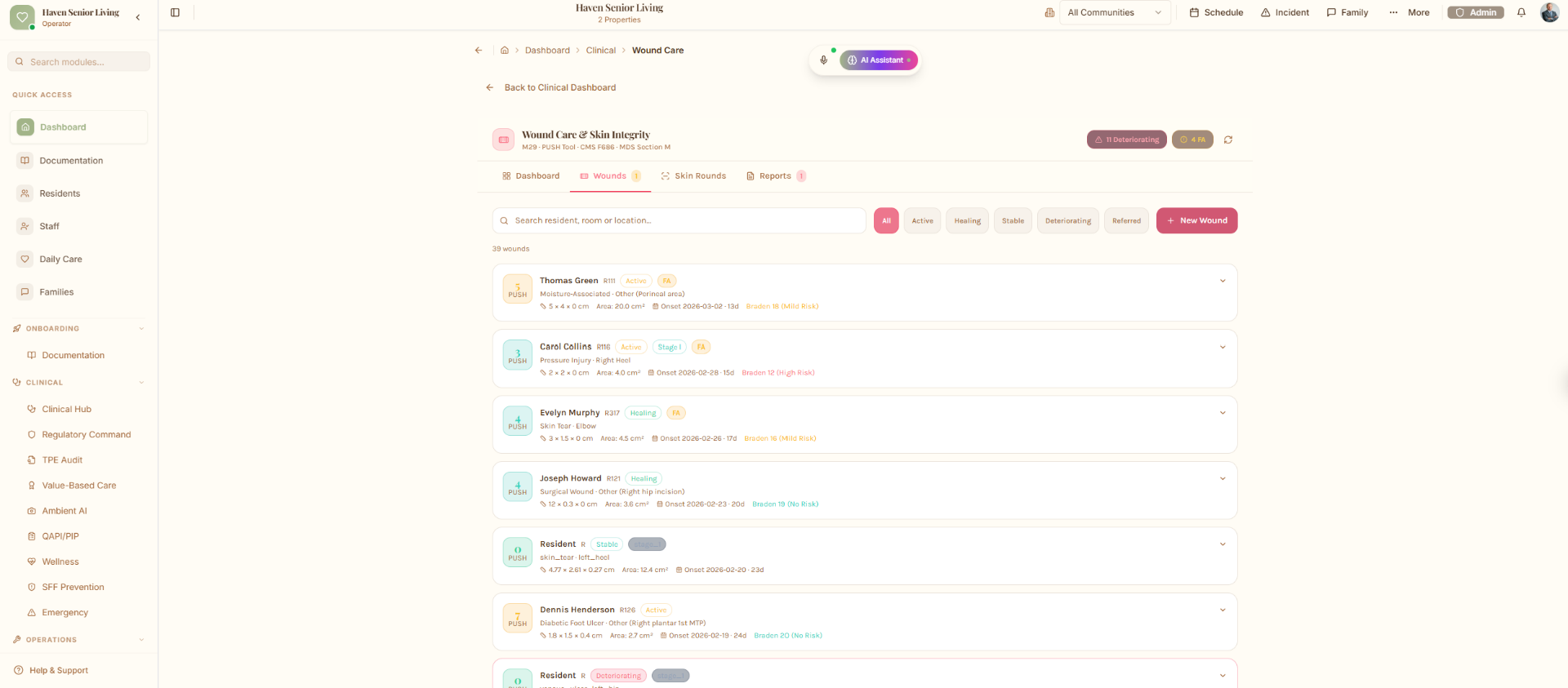
Pressure injury risk escalation
“Stage 2 risk trending up on 4 residents.” Skin integrity rounds, Braden scoring, and repositioning logs are held in the record so the pattern is visible before it is read from a monthly report.
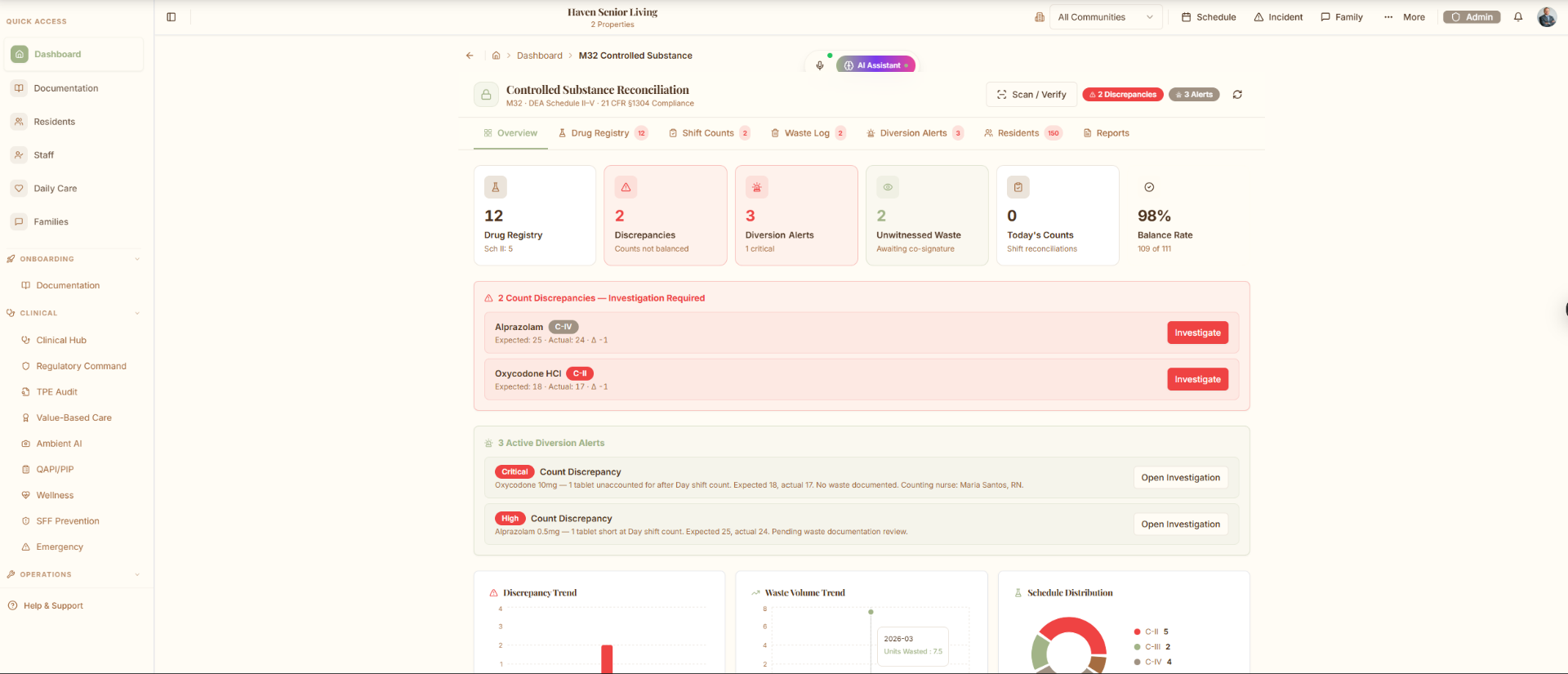
Behavioral baseline drift
“Behavioral baseline deviation on 6 memory care residents.” PRN psychotropic frequency and trigger patterns surface against a recorded baseline rather than a free-text note.
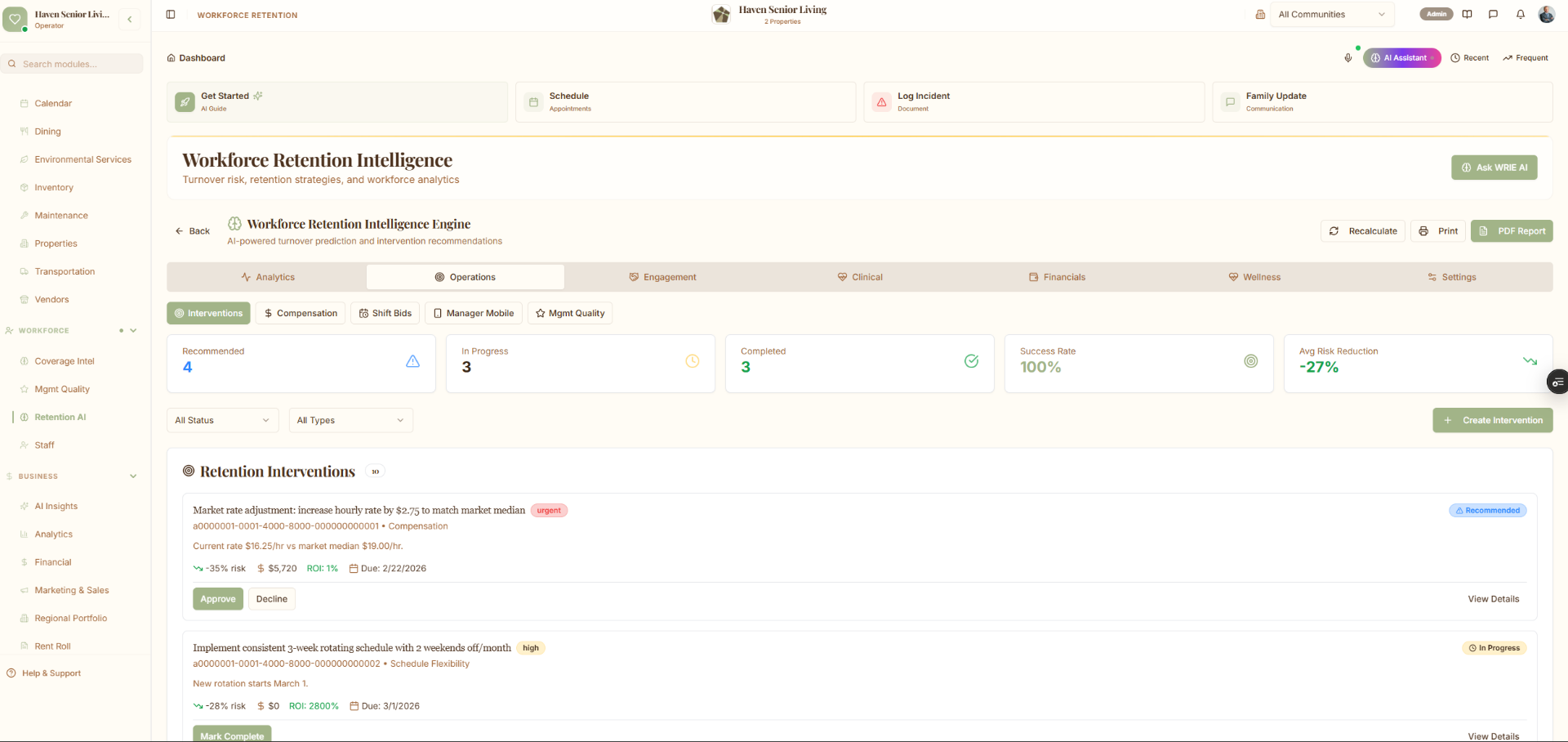
Nurse workload alert
“Nurse utilization at 87% on Unit 2.” The workload model fires against an operator-declared utilization threshold, so the schedule can move before retention does.
Mapped to what 2026 healthcare buyers are buying
Senior housing and care was not in the Bain Healthcare IT 2026 dataset. The same four buyer priorities that govern hospital IT now apply to operators, REITs and lenders in senior housing & care.
01
Revenue cycle and denials prevention
Hospital and post-acute boards are funding revenue-cycle modernization first, which makes claim-level definitions a governance question.
- Payer-rule engine with SNF / AL / MC / IL coverage and active-room locks
- MDS reconciliation with clinical context pull-forward
- All-payer Medicaid billing rails (case-mix, room-and-board, leave days)
- Controlled-substance chain-of-custody counts on the eMAR
02
Clinical workflow optimization
Workforce burnout is the operating constraint. Buyers want documentation burden reduced, not added.
- WebRTC ambient voice dictation
- Documentation context pull-forward from prior charts
- Nurse workload alert against an operator-declared utilization threshold
- Med Tech and controlled-substance controls on the eMAR critical path
03
Care coordination and utilization management
Cross-setting coordination is written into payer agreements rather than treated as a value-add.
- Unit-level data feeding threshold alerts on the operating record
- QM Engine 2026 CMS Quality Measure reconciliation and QAPI tracking
- High-acuity care coordination with ambient monitoring and emergency triage
- Operator-supplied clinical exports through the documented ingestion path (HL7 v2, FHIR, CSV); named-vendor connectors are ROADMAP and not live in operator production
04
AI built and validated, not slideware
Buyers penalize AI demoware. They want validate → prove → scale evidence.
- Four AI surfaces (PIIEL, WRIE, LCIFS, ALIRP) built, not yet validated, not operator-deployed
- Ambient documentation exercised against synthetic and de-identified data
- Every AI surface reports its override rate alongside the measure it informs
- No external user logins — internal staff operate the surface
Native to senior housing & care, not retrofitted
| The retrofit approach | How SeniorCRE is built |
|---|---|
| Acute-care EHRs bolted onto post-acute | PDPM, MDS 3.0, QM 2026, M32 and Five-Star as first-class entities, not retrofitted |
| Hospital revenue cycle tuned for DRGs and CPT | SNF/AL/MC/IL payer rules, case-mix, room-and-board, leave days, HCBS waivers |
| Results reported by the vendor rather than measured on the operator’s baseline | Validate → prove → scale, measured against baselines the operator supplies |
| “All-in-one” suites where reporting definitions are set by the vendor | One record across clinical, revenue cycle, occupancy and workforce, under definitions the operator declares |
What the clinical record holds
Read as a description of the record, not a comparison scorecard. Every row states its own status.
| Dimension | What is recorded | Status |
|---|---|---|
| PDPM / MDS 3.0 | First-class entity, reconciled to the claim | Built; not validated; not operator-deployed. |
| QM Engine 2026 | CMS Quality Measure reconciliation with QAPI tracking | Definitions and thresholds are declared by the operator. |
| M32 controlled substances | DEA-aligned shift counts on the eMAR | Chain-of-custody counts recorded at administration. |
| Ambient documentation | WebRTC capture with context pull-forward | Validated against synthetic and de-identified data. |
| Acuity coverage | SNF · AL · Memory Care · IL | State variation and payer rules held in the data model. |
| Audit trail | Append-only on every clinical write | Lineage preserved for each recorded value. |
| How results are measured | Against baselines the operator supplies | SeniorCRE publishes no measured customer outcome. |
What we will not build
The fastest way to lose a clinical license, and an operator’s trust, is to build clinical AI that crosses the line. We do not cross it.
Autonomous clinical decisioning
No FDA SaMD-class diagnostic AI. The licensed clinician is always in the loop.
AI that writes physician orders
Orders are intake-and-structure only. The licensed prescriber remains the authoritative source.
External-user PHI logins
Families, vendors, and physicians never log in to the clinical surface.
Mock or synthetic production data
Placeholder seeds are banned in operator surfaces. Empty states beat invented numbers.
Back to the argument
The case for governing the clinical record is made on the main clinical platform page.