You are paying rent on your own operating history
Your institutional operating memory — what the organization knew, what governed, what it decided, and what happened — is scattered across systems you do not govern.
SeniorCRE Editorial Team · August 31, 2026
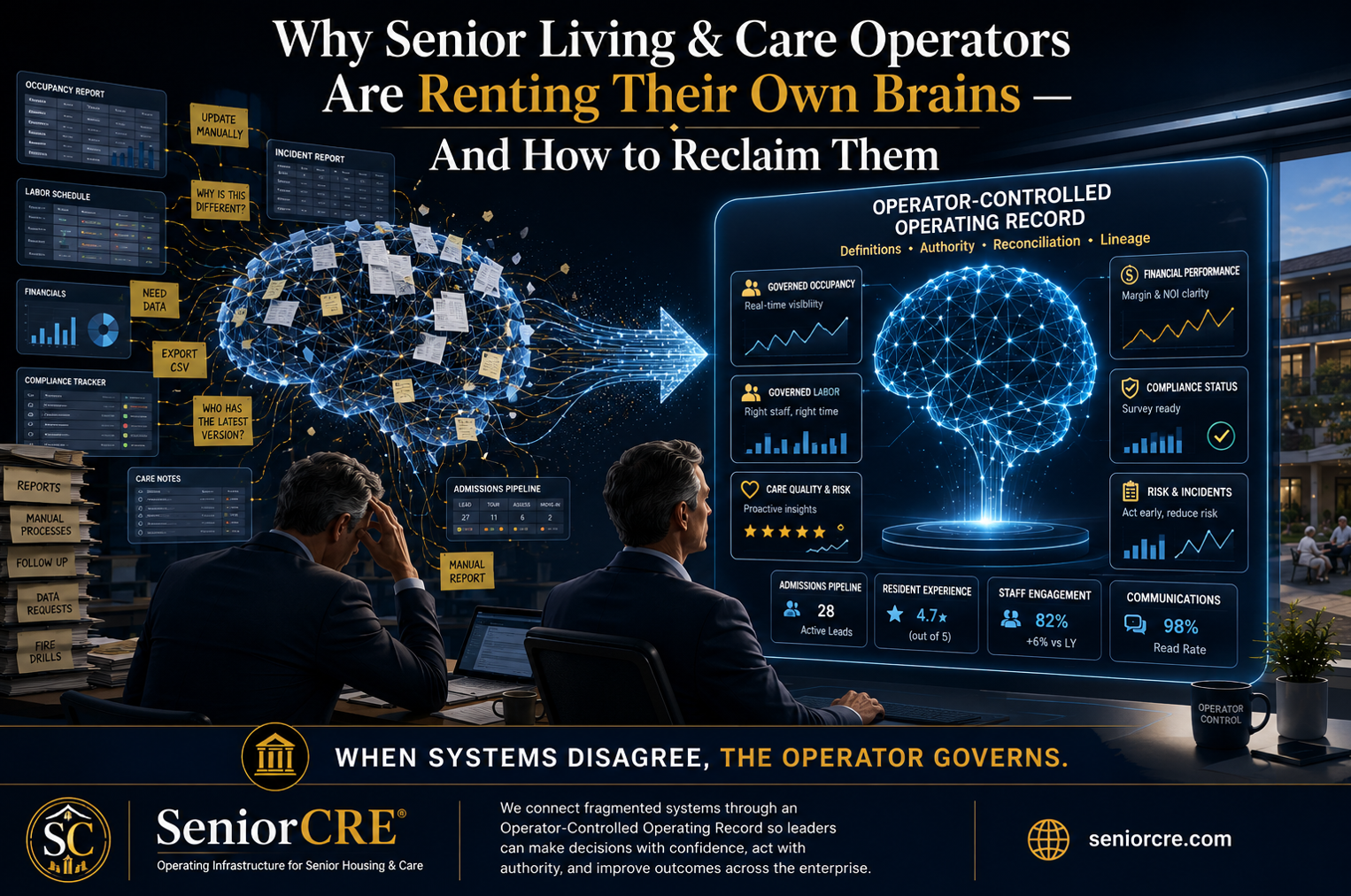
Illustrative governance diagram. Figures shown are illustrative design intent, not operator results, customer deployments, production performance, or verified outcomes.
The argument in three lines
- Every system in the stack holds a fragment of the organization’s operating memory, and no system holds the connective tissue between them.
- Contractual ownership of data is not operational control of truth: control means definitions, source authority, reconciliation, and lineage the operator holds.
- The remedy is not a friendlier vendor. It is an operator-controlled operating record above the systems already running the buildings.
Ask a senior housing & care or care executive a simple question — why did occupancy at that community move the way it did last quarter? — and watch what happens. Nobody answers. Somebody starts gathering.
A census report comes out of one system. Tour and inquiry history comes out of another. Acuity and care-minute data comes out of the clinical record. Staffing comes out of scheduling and payroll, which disagree with each other about hours. Revenue comes out of billing, which uses a different month-end than the general ledger. Somebody exports. Somebody reconciles. Somebody remembers what the rate exception was for.
Two weeks later a number appears in a board deck. It is probably right. Nobody can prove it, and nobody can reproduce it — not because the organization is careless, but because the memory of the decision never lived anywhere the organization governs.
What “renting your own brain” actually means
Institutional memory is distributed across vendor systems, and the operator holds only the fragments each vendor chose to expose.
An operating business has a memory. It knows what it agreed to, what it charged, who worked, what care was delivered, what was reported to regulators, what it decided when two facts conflicted, and why. In senior housing & care, that memory is partitioned:
- EHR / eMAR — clinical history, assessments, medication administration, acuity as the clinical system defines it.
- CRM — inquiry, referral source, tour history, the reasons a prospect did or did not move in.
- Workforce — scheduled hours, worked hours, agency usage, turnover, and the labor cost actually incurred.
- Finance — billed revenue, collections, expense allocation, the ledger the auditors read.
- Compliance — what was reported, when, under which definition, and what remains open.
- Property & operations — the physical asset, work orders, capital projects, and the condition record.
Each vendor keeps its fragment faithfully. None of them keeps the operator’s memory, because the operator’s memory is the relationship between the fragments: the resident whose acuity rose, which raised care minutes, which broke the staffing plan, which triggered agency cost, which moved margin, which shows up in a covenant calculation two quarters later. That chain is the institution’s knowledge. Today it is reassembled by hand, every time, by whoever happens to be available.
Ownership is not control
A contractual right to a copy of your data does not tell you which copy governs.
Most operators can point to a clause. The data is theirs. They can export it. That is real, and it is not the same as control. Control is answering four questions without convening a committee:
- Definitions — what does this value mean, in force as of when, approved by whom?
- Authority — when two systems report different values, which one governs, and who decided that?
- Reconciliation — how was the disagreement resolved, and was the exception approved or silently overwritten?
- Lineage — how does the published number trace back to the row that produced it?
Aggregation does not answer those questions. A warehouse, a lake, an interoperability layer, or an AI overlay can connect data and make conflicts visible. Aggregation connects data. Authority determines what governs. That distinction is the whole architecture, and it is developed at /operating-record.
The cost shows up as fire drills
Reconstruction labor, disputed numbers, and slow answers are the recurring price of distributed memory.
Operators rarely record this cost as a line item, so it is easy to underestimate. It appears instead as the analyst who spends the first week of every month rebuilding the same reconciliation, the regional who does not trust the dashboard and keeps a private spreadsheet, the owner who receives a different occupancy figure than the lender did, and the survey response that depends on someone locating a document.
It also appears as institutional forgetting. When the person who understood why a rate exception existed leaves, the reason leaves with them. The organization keeps the number and loses the judgment behind it. SeniorCRE does not publish a savings figure for this; the honest position is that the magnitude is measured in an operator’s own data, with the operator’s own definitions, using the method disclosed at /exposure-method.
Reclaiming institutional memory
The operator can govern the systems in the buildings or assign selected system-of-record functions to SeniorCRE.
On the retain-and-govern road, systems may stay authoritative for their domains: the clinical record for clinical data, payroll for labor, the general ledger for finance. Where an operator deliberately chooses otherwise, SeniorCRE can assume selected system-of-record functions itself — including EHR and eMAR. Either way, what the operator needs is one layer above them where the enterprise decision is governed — the operator-controlled operating record, built on definitions, authority, reconciliation, and lineage the operator holds.
That record turns four scattered artifacts into one governed path: DATA → TRUTH → DECISION → EXECUTION — what systems reported, what the operator accepts as authoritative, what the operator determined should happen, and what was authorized to occur. The mechanism is set out in the Operator Authority Chain™. When systems disagree, the operator governs.
One caution, stated plainly because it is the point of the piece: SeniorCRE does not become the operator’s brain. Substituting a new vendor’s judgment for the old vendors’ would repeat the problem in nicer packaging. The operator sets the definitions, holds source authority, approves the reconciliation rules, and keeps the lineage. The infrastructure’s job is to make that authority explicit, enforceable, and reconstructable — and clinical configuration remains the operator’s choice, as described at /ehr-emar.
Your data. Your definitions. Your authority. Your operating memory.
Why it matters now
Automation raises the cost of distributed memory, because an agent inherits every disagreement beneath it.
For twenty years the consequence of fragmented memory was slow reporting. That was tolerable. It stops being tolerable when models and agents begin reading the record and proposing action, because an inference drawn across conflicting definitions is confident and indefensible at the same time. Govern the truth before you automate the decision — the case is made at /ai-governance and /why-now.
Notes
SeniorCRE is the operator-controlled operating infrastructure for senior housing & care. Operator Authority Chain™ is a mark of SeniorCRE, LLC. This article is a perspective on operating architecture and institutional knowledge; it is not legal, accounting, clinical, or investment advice. No named operator, deployment, or production result is described or implied.
Frequently asked questions
What does “renting your own brain” mean?
Each system in the stack holds part of the organization’s operating memory: the EHR/eMAR holds clinical history, the CRM holds the inquiry and tour history, workforce holds who actually worked, finance holds what was billed and collected, compliance holds what was reported, property and operations hold the physical asset record. The operator owns that data contractually, but the connective memory — what was known, what governed, what was decided, and what happened — exists only in exports, spreadsheets, and the recollection of the people who were in the room.
Isn’t owning the data the same as controlling it?
No. Ownership is a contractual right to a copy. Control is the ability to state which definition applies, which source has authority when two systems disagree, how the disagreement was reconciled, and how any published number traces back to the row that produced it. A data export gives you the first and none of the rest.
Does SeniorCRE become the operator’s brain?
No, and the distinction matters. SeniorCRE does not become the institution’s memory or its judgment. It is the infrastructure through which the operator controls and preserves its own institutional operating memory: the operator sets the definitions, holds source authority, approves reconciliation, and retains lineage. When systems disagree, the operator governs.
Does this require replacing the EHR or eMAR?
Clinical configuration is an operator choice. SeniorCRE clinical record surfaces are built; medication administration and eMAR remain roadmap — not built. An operator may retain an incumbent EHR/eMAR and govern authorized clinical data through the SeniorCRE operating record. Neither configuration is a prerequisite for adopting the operating infrastructure.
Where does this stop being philosophy and become operational?
At the moment a board, lender, REIT, surveyor, or plaintiff asks how a number was produced. Reconstructing the decision — the inputs available at the time, the definition in force, the source that governed, the approval, and the action taken — is either a property of the record or a research project. That is what the Operator Authority Chain™ (DATA → TRUTH → DECISION → EXECUTION) is for.