Robotics in Senior Housing & Care: The Next Five Years
Humanoid platforms are leaving the lab. Spatial computing is already in the memory-care neighborhood. Japan and China are scaling robotics as eldercare infrastructure. Between 2026 and 2030, the operators that win will be the ones whose operating layer can ingest the signal stream these machines produce.
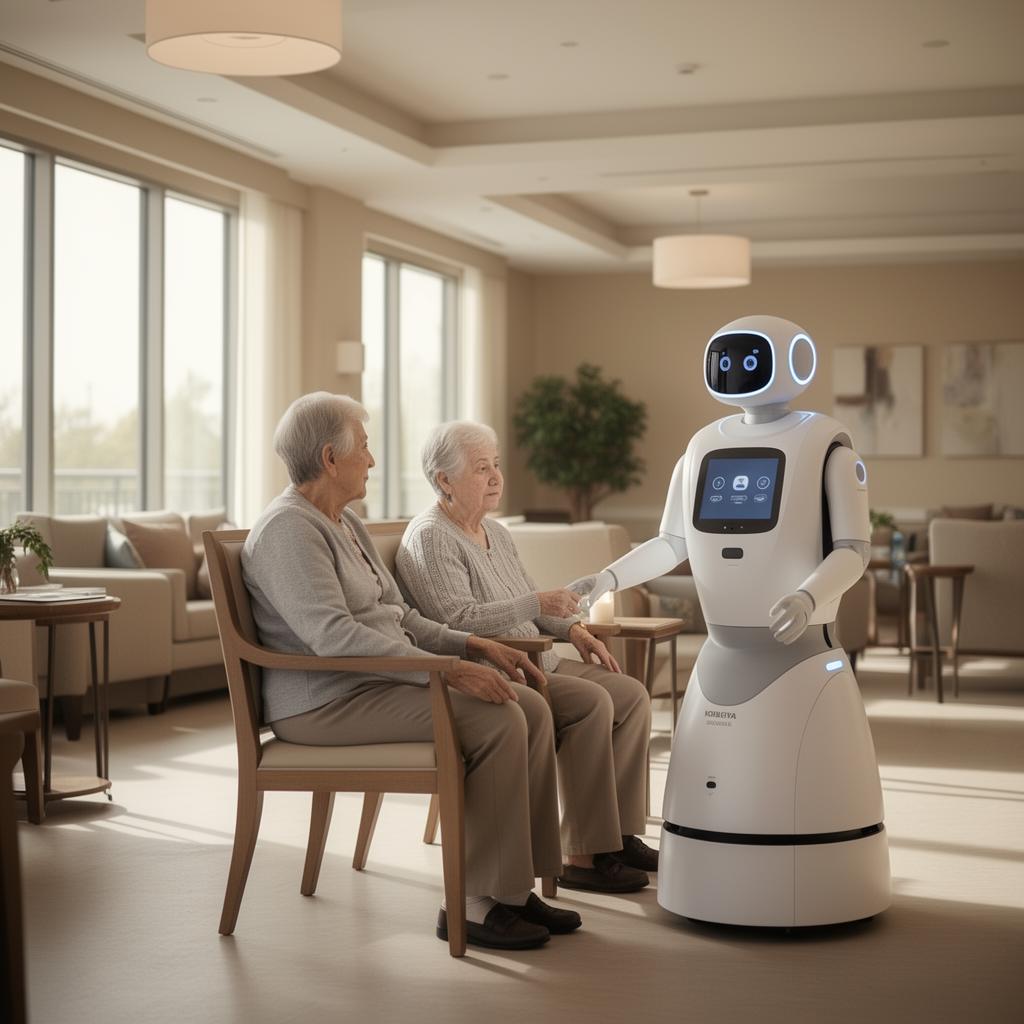
The senior housing & care sector is staring down two compounding curves at once. On one side, the 80-and-over population is the fastest-growing cohort in the United States and the leading edge of the global aging wave. On the other, every developed economy is short the caregivers needed to serve it — the U.S. Bureau of Labor Statistics projects 818,000 direct-care openings per year through 2032, and Japan is already 380,000 caregivers short of the 2026 requirement set by its Ministry of Health, Labour and Welfare.
Software alone does not close that gap. Embodied machines do. Over the next five years, three classes of robotics — humanoid general-purpose robots, spatial-computing headsets, and ambient sensing — will move from pilot to production inside assisted living, memory care, independent living, and skilled nursing. The operators who capture the resulting outcome and resident-data signal will compound. The operators who treat robots as standalone amenities will leave the value on the floor.
The framing
Robotics in senior housing & care is not a hardware story. It is a data ingestion story. Every humanoid, every VR session, every ambient radar, every dining robot, every transfer aid generates structured signal about the resident, the workforce, and the community. The platform that can read that signal into one operator-controlled operating record is the one that turns embodied AI into governed definitions, declared source authority, reconciliation of differences, and preserved lineage.
The Six Robotics Categories Landing in Communities by 2030
The robotics that matter for senior housing & care are not a single product. They are six distinct categories — each on a different cost curve, each producing a different data stream, and each interacting with a different workflow inside the operating layer.
Humanoid General-Purpose Robots
Figure 03 (Figure AI, 2025) and Tesla Optimus (Tesla AI, Gen 2/3 roadmap) are the first humanoids engineered for unstructured human environments — soft textile-covered or compliant limbs, dexterous end-effectors, on-board vision-language-action models, and inductive or fast-swap charging. The same form factor that folds laundry and clears a meal tray in a Bay Area home is what will walk into assisted living memory care neighborhoods between 2027 and 2030.
Spatial Computing and Mixed Reality
Meta Quest 3 / 3S and the Oculus successor program are already deployed by MyndVR, Rendever, and Embodied Labs for reminiscence therapy, anxiety reduction in memory care, and clinician empathy training. The headset is no longer a novelty — it is a clinical instrument that produces engagement, vitals, and cognitive-decline signals worth ingesting.
Social and Companion Robots
Japan’s PARO therapeutic seal (AIST), SoftBank’s Pepper, and Intuition Robotics’ ElliQ are in active deployment for loneliness, depression, and medication-adherence prompting. CMS-funded ElliQ pilots in New York and Florida have logged measurable reductions in self-reported loneliness scores.
Mobility, Transfer, and Rehab Robots
Toyota’s Human Support Robot (HSR), Cyberdyne HAL exoskeletons, and RIKEN’s ROBEAR lift-assist are reducing the leading cause of caregiver injury in Japan — resident transfers. Hocoma Lokomat and Ekso Bionics handle post-stroke and post-fall gait rehab inside skilled nursing.
Ambient Sensing and Passive Monitoring
mmWave radar (Walabot HOME, Tellus), contactless vitals (Emerald AI), and acoustic AI for cough, fall, and call-for-help detection are the quiet robotics layer — no camera, no wearable, no resident burden — generating the highest-signal data stream in the entire community.
Service, Logistics, and Environmental Robots
Bear Robotics Servi for dining delivery, Pudu BellaBot in 25,000+ deployments globally, Aethon TUG for med-pass and linen logistics, and UV-C disinfection robots (Xenex, UVD Robotics) running every night between 2 a.m. and 5 a.m. in post-COVID infection-control programs.
Figure 03: The First Humanoid Engineered for the Home
Figure AI’s third-generation humanoid, Figure 03, is the most consequential hardware release for eldercare in a decade — even though it was not designed for senior housing & care. Public materials from Figure point to a platform engineered for safe operation in unstructured human spaces: compliant limbs suitable for environments where a resident may be ambulatory or in a wheelchair, dexterous manipulation for fine tasks (medication packets, utensils, a dropped TV remote), hands-free charging, and on-board vision-language-action models that allow the robot to operate without a tethered cloud. Specific hardware details will evolve generation to generation; the capability envelope — humanoid form factor, dexterous hands, on-device autonomy — is what matters for the operating model.
For senior housing & care, the implication is direct. By 2028–2029, a humanoid form factor will be economically defensible for community-side tasks that today consume clinical and hospitality labor: meal-tray pickup, linen exchange, laundry runs, hydration rounds, dementia-friendly wandering redirection, and medication-cart escort. Every one of those tasks today produces no data. With a humanoid in the loop, each becomes a structured event — timestamped, resident-linked, and ready to feed the operating record.
Cost curve operators should plan against. Industry guidance from Figure, Agility Robotics, and 1X targets a sub-$50,000 humanoid unit price at scale, with leading analysts (Goldman Sachs Humanoid Robot report, Morgan Stanley) modeling a $20,000–$40,000 band by the end of the decade. On a Robotics-as-a-Service basis, that translates to a planning range of roughly $1,500–$3,000 per humanoid per month fully loaded (hardware amortization, software, connectivity, maintenance, insurance) — call it $30–$60 per licensed bed per monthin a 100-unit community running 2–4 humanoids. That is the same order of magnitude as a single agency-shift premium, and it is the number to budget against in 2027–2028 capex planning.
Named U.S. pilots to watch. Front Porch’s Humanly innovation lab has fielded ElliQ (Intuition Robotics) across independent-living residents in California, with CMS-funded deployments at the New York State Office for the Aging and the Florida Department of Elder Affairs producing the first large-N loneliness-reduction findings in the U.S. Eskaton, Maplewood Senior Housing & Care, and the Front Porch / Stanford Center on Longevity collaboration are running Pepper, Rendever (Quest 3-based reminiscence VR), and MyndVR programs at scale. Humanoid pilots in senior housing & care remain pre-commercial in the U.S. as of 2026; the first announced deployments are expected 2026–2027, and operators should track Figure, Agility, and 1X partnership announcements as the leading indicator.
The realistic five-year curve is not "humanoids replace caregivers." It is "humanoids absorb the 30–40% of caregiver time that is logistics, transport, and environmental work — and return that time to the bedside." That is the Clinician Hours Returned outcome the 2026 healthcare buyer is contracting on, expressed in steel and silicone.
Where the incumbents are. The dominant senior-living and post-acute software stacks — PointClickCare®, MatrixCare (ResMed), Yardi Senior Living Suite, Eldermark, and ALIS — have no published robotics-ingestion roadmap as of 2026. Integrations to ambient sensors, VR platforms, and service robots exist piecemeal at the customer level, typically via flat-file export or bespoke HL7 feeds. There is no incumbent platform today that lands a Figure 03 event, a Quest 3 session, a Walabot radar alert, and a BellaBot delivery ping in the same resident record with the same provenance and the same downstream consumption. That is precisely the wedge SeniorCRE was architected for — and it is why the robotics wave is an enterprise-value accelerant for operators on a modern data model, and a fragmentation tax for operators staying on legacy stacks.
Meta Oculus, Quest 3, and the Spatial-Computing Layer
Meta’s Oculus line — now consolidated under the Quest 3 and Quest 3S platforms, with the next- generation headset publicly roadmapped for 2026–2027 — has quietly become the most-deployed clinical instrument in U.S. senior housing & care after the blood-pressure cuff. MyndVR, Rendever, and Embodied Labs have logged tens of thousands of resident sessions covering reminiscence therapy, travel and nature immersion, intergenerational family visits, and clinician dementia-empathy training.
Three things change in the next five years. First, weight and field-of-view improvements make the headset tolerable for residents with mild-to-moderate cognitive impairment, not just the cognitively intact independent-living cohort. Second, eye-tracking and pupillometry — already shipping in Quest Pro and the consumer roadmap — turn each session into a longitudinal cognitive-decline biomarker. Third, mixed-reality pass-through allows clinicians and therapists to overlay rehab cues onto the resident’s real environment, collapsing the gap between rec therapy and clinical therapy.
Each of those sessions produces data: engagement duration, gaze patterns, anxiety indicators, social interaction frequency, and self-reported mood. Treated as a calendar amenity, that data dies in the headset. Treated as clinical signal, it pre-populates the Resident Wellness 7-pillar record and feeds the High-Acuity Care Coordination workflow weeks before a traditional MDS assessment would catch the change.
Japan and China Are Already Living the 2030 Operating Model
The United States senior housing & care sector tends to treat robotics as a 2030-and-beyond question. Japan and China have been treating it as a 2015-and-onward operating reality. Looking at how those two markets have institutionalized eldercare robotics is the cleanest forecast available for what U.S. operators will be running by 2030.
Japan — METI Robot Care Devices Program
Japan faces a projected shortfall of 380,000 care workers by 2026 and has run a national subsidy program since 2013 covering six priority robot categories: transfer assistance, mobility, toileting, monitoring, bathing, and care-record automation. RIKEN ROBEAR, Toyota HSR, Cyberdyne HAL, and PARO are now installed across thousands of long-term care facilities, with reimbursement built into the Long-Term Care Insurance system.
China — 14th Five-Year Plan and Silver Economy
China’s 14th Five-Year Plan (2021–2025) explicitly funds eldercare robotics as part of the "silver economy." Unitree, Fourier Intelligence, and UBTech are deploying humanoid and rehabilitation robots into state-run elder communities, with the State Council’s 2024 directive on the silver economy naming embodied AI as a strategic pillar. By 2030, China’s 65+ population will exceed 300 million — and the operating model being built is robot-augmented per design, not retrofitted.
South Korea and Singapore — fast followers
South Korea’s "K-Robot 2030" and Singapore’s Smart Nation eldercare pilots (using Pepper, ElliQ, and locally developed transfer aids) confirm the pattern: every aging society with a labor shortage is treating robotics as infrastructure, not amenity.
The takeaway is uncomfortable but clear: in markets where the labor crunch arrived earlier, robotics stopped being a futurism conversation and became a reimbursement-and-procurement conversation. The same compression is now arriving in the U.S. The five-year question is not whether robotics lands in senior housing & care — it is which operators have an operating layer ready to read the signal these machines produce.
How SeniorCRE Ingests the Robotics Signal Stream
SeniorCRE was built on one operator-controlled operating record across six entities — Resident, Care Plan, Ledger, Shift, Property/Unit, and Entity. That architecture is the reason robotics signal is not a side project; it is a first-class input to the record every clinician, operator, family member, regulator, capital partner, and broker reads from.
Contactless Vitals and Sleep
mmWave + acoustic sensors stream heart rate, respiration, restlessness, and bed-exit events directly into the Resident record — feeding the Resident Wellness 7-pillar framework and the High-Acuity Care Coordination workflow.
Fall, Gait, and Decline Detection
Radar-based gait analysis and humanoid-vision fall detection raise predictive flags weeks before a clinical incident — pre-populating the Fall Prevention Program and Documentation Context Pull-Forward.
Engagement and Cognitive Signals
VR session telemetry (Quest 3 / Rendever / MyndVR), companion-robot conversation cadence, and dining-robot interaction patterns become longitudinal cognitive-decline and depression signals — not just activity-calendar checkboxes.
Workload and Moral-Injury Telemetry
Logistics and transfer robots return measurable hours to clinicians — feeding the 80% clinician-workload alert threshold and the Clinician Hours Returned outcome the 2026 buyer is contracting on.
Ingestion runs through the C2 Canonical Data Layer (FHIR-aligned, schema-normalized, append-only audit logs) so a Figure 03 event, a Quest 3 session, a Walabot radar alert, and a BellaBot delivery ping all land in the same Resident record with the same provenance, the same RLS scoping, and the same downstream consumption by the QM Engine 2026, the Fall Prevention Program, the Clinician Workload Alert, and the Executive Intelligence portfolio view.
Better Resident Outcomes, Mapped to the Four That Get Contracted
Robotics only matters in senior housing & care to the extent it moves the four outcomes the 2026 buyer is willing to contract on. Mapped directly:
- Cleaner claims. Ambient vitals, fall, and decline detection produce the contemporaneous, time-stamped, audit-grade documentation that survives denial review and supports PDPM, MDS 3.0, and HCBS waiver capture.
- Clinician hours returned. Logistics, transfer, dining, and disinfection robots give 45–90 minutes back per nurse per shift — on top of the ambient WebRTC voice dictation and context pull-forward already in production today.
- Occupancy lift. Communities running a visible robotics-augmented care model convert tours at materially higher rates with the 2026 adult-child decision-maker. The signal a family wants to see — "my mother will not be alone, she will not be ignored, and she will not be rushed" — is exactly what a humanoid, a companion robot, and a spatial-computing engagement program communicate on the tour.
- Audit-grade survey readiness. Every robot interaction is a structured event with an immutable timestamp. That is the survey defense surveyors and plaintiffs’ attorneys both ask for, expressed in the data model rather than in a binder.
Governance, Dignity, and the Lines That Do Not Move
Robotics in eldercare carries failure modes that pure software does not. Three governance lines hold across the five-year horizon, and SeniorCRE enforces all three at the data layer:
- Human-in-the-loop on every clinical, billing, and survey decision. A humanoid can observe a fall risk. A clinician decides the care plan response. A radar can flag a missed bed-exit. A nurse signs the note. No robot signs the MAR.
- Dignity-first deployment. No camera in a resident bathroom or bedroom unless the resident or POA has opted in with a documented care-plan rationale. Ambient mmWave radar is the preferred bedroom sensor precisely because it captures vitals and fall events without producing imagery.
- Family transparency without PHI leakage. Per the Family Access Governance standard, robotics-derived signal flows to families as engagement, wellness, and presence indicators — never as raw medication, diagnosis, or clinical-note content.
The Tasks Robots Will Actually Complete (2026–2030)
The near-term robotics opportunity in senior housing & care is not general-purpose autonomy. It is a disciplined band of repeatable, low-judgment, high-frequency tasks that today consume the majority of a caregiver’s shift and produce most of the documentation burden. The five-year envelope looks like this:
- Resident transfers and repositioning. Sit-to-stand, bed-to-chair, toileting transfers, and every-two-hour repositioning — the single largest source of caregiver back injury and workers’ comp loss — handled or assisted by Cyberdyne HAL, Toyota HSR, RIKEN ROBEAR, and next-generation humanoids (Figure 03, Tesla Optimus).
- Medication delivery and adherence prompting. Locked-cart navigation from the med room to the resident, paired with ElliQ-style verbal prompting and barcode/biometric confirmation. The eMAR record gets a chain-of-custody event the surveyor can audit.
- Dining and hydration service. Pudu BellaBot, Keenon, and Bear Robotics platforms run tray delivery, hydration rounds, and snack pass — measurable intake captured at the source instead of reconstructed at end-of-shift.
- Housekeeping, laundry, and turnover. Floor care, soiled-linen transport, and unit turnover between admissions — the lowest-engagement work that today pulls aides away from residents.
- Ambient monitoring and fall detection. Walabot, radar, computer-vision ceiling sensors, and humanoid patrol replace check-rounds with continuous, documented presence — every fall, near-fall, and elopement timestamped and reconstructable.
- Engagement, companionship, and cognitive stimulation. ElliQ, PARO, Pepper, and Meta Quest 3 sessions fill the long stretches between care touches with measurable social-interaction and cognitive-engagement data.
- Vitals capture and skin/wound surveillance. Contact-free vitals (heart rate, respiration, SpO₂), gait analysis, and weekly skin imaging executed by stationary or mobile robotics — straight into the Resident Wellness 7-pillar record.
- Logistics and supply runs. Inter-unit pharmacy, linen, lab specimen, and supply transport on autonomous carts — a recovered 30–60 minutes per shift per caregiver.
None of these tasks require artificial general intelligence. All of them require an operating layer that can ingest the resulting event stream, attribute it to a resident, normalize it against the care plan, and surface it to the right human at the right time. That is the C2 Canonical Data Layer feeding the one operator-controlled operating record.
Robotics and the Staffing Crisis
The U.S. senior housing & care workforce is the binding constraint of the next decade. Argentum, AHCA/NCAL, and LeadingAge have published consistent industry findings: the sector needs roughly 3 million additional direct-care workers by 2030 against a labor pool that is shrinking, aging, and competing with retail, hospitality, and warehouse wages. Turnover in assisted living routinely clears 50% annually; in skilled nursing, certified nursing assistant turnover frequently exceeds 100%. Open shifts, agency premiums, and admission holds are now the single largest drag on NOI.
Robotics does not solve this crisis by replacing caregivers. It solves it by giving the caregivers who remain back the hours that today are absorbed by transfers, hydration rounds, supply runs, charting, and documentation. The realistic five-year arithmetic — based on Japanese deployments, early U.S. pilots, and the humanoid roadmap — looks like this:
- 1.5 to 3.0 caregiver hours returned per resident per week by the end of 2028 in communities running a coordinated robotics layer (ambient monitoring + dining/logistics robots + one transfer-assist platform). That is the Clinician Hours Returned outcome made contractable.
- 40–60% reduction in caregiver musculoskeletal injury in units running transfer-assist robotics — the headline result from a decade of Japanese long-term care deployments of HAL and ROBEAR. Lower workers’ comp, lower turnover, lower agency spend.
- Moral-injury and workload-alert thresholds (80% nurse workload) become enforceable for the first time, because the operating layer can see actual task load — not just the schedule — and rebalance before the caregiver burns out.
- Documentation collapse. Robotics-generated events (transfers, intake, vitals, ambulation, engagement) auto-populate the chart instead of being reconstructed by an exhausted aide at 11 p.m. Surveys become defensible by design — the Audit-Grade Readinessoutcome.
- Census protection. Communities that today hold beds open because they cannot staff them recover admission capacity. That is direct Occupancy Lift — and the same signal feeds the Capital Layer for lenders and REIT partners.
The operators that win this curve will not be the ones with the most robots. They will be the ones whose operating layer turns every robotic event into a clinical, financial, and regulatory artifact the entire enterprise can trust. The robots are a labor-arbitrage instrument; the data model is the durable enterprise asset.
The Bottom Line
Robotics in senior housing & care is not the chrome-plated future. It is the operating substrate of the next five years. Humanoid platforms led by Figure 03, spatial computing led by Oculus / Quest 3, companion and rehab robotics already proven in Japan, and the state-funded silver-economy buildout in China all point at the same horizon: between 2026 and 2030, the median U.S. senior housing & care and care community will run a meaningful robotics layer, and the resident record will be richer for it by an order of magnitude.
The operator advantage is not owning the robots. It is owning the operating layer that reads them. One operator-controlled operating record. Four contractable outcomes. One record the entire enterprise — clinical, financial, regulatory, capital, family — reads from. That is what SeniorCRE was built for, and it is what makes the robotics wave additive to enterprise value rather than another fragmented spend.
External sources: Figure AI · Meta Quest · Tesla Optimus / AI · METI Robot Care Devices · RIKEN ROBEAR · Cyberdyne HAL · ElliQ (Intuition Robotics) · PARO Therapeutic Robot · BLS Healthcare Occupational Outlook
Key Takeaways for Operators and Investors
- Robotics in senior housing & care is a data-ingestion story, not a hardware story.
- Figure 03, Oculus / Quest 3, and ambient sensing are the three classes moving from pilot to production by 2030.
- Japan and China have already institutionalized eldercare robotics with state reimbursement and five-year plans — the U.S. is a fast follower, not the leader.
- The operator advantage is controlling the authority layer that reads the robots — not owning the robots themselves.
These insights are derived from publicly available industry research and cited sources.
Get this article as a PDF
Save it for your team, share it with stakeholders, or read it offline. No email required.
Frequently Asked Questions
- What robotics are realistically landing in senior housing & care by 2030?
- Six categories: humanoid general-purpose robots (Figure 03), spatial-computing headsets (Oculus / Quest 3 and successors), social and companion robots (PARO, ElliQ, Pepper), mobility/transfer/rehab robots (Toyota HSR, Cyberdyne HAL, ROBEAR), ambient sensing (mmWave radar, contactless vitals, acoustic AI), and service/logistics/disinfection robots (Bear Robotics Servi, Pudu BellaBot, Aethon TUG, Xenex UV-C).
- How are Japan and China using robotics in senior housing & care today?
- Japan has subsidized six priority robot care categories under METI since 2013, with reimbursement built into Long-Term Care Insurance — RIKEN ROBEAR, Toyota HSR, Cyberdyne HAL, and PARO are deployed across thousands of facilities. China’s 14th Five-Year Plan and 2024 silver-economy directive fund Unitree, Fourier Intelligence, and UBTech robotics into state-run elder communities serving a 65+ population that will exceed 300 million by 2030.
- How does SeniorCRE turn robotics signal into better resident outcomes?
- Every robotics event — Figure 03 task, Quest 3 session, mmWave vitals stream, dining-robot interaction — lands in the same Resident record through the C2 Canonical Data Layer with append-only audit logs and FHIR-aligned schema. That feeds the four contractable outcomes: governed definitions, declared source authority, reconciliation of differences, and preserved lineage.
- Will humanoid robots replace caregivers in senior housing & care?
- No. The realistic 2026–2030 curve is humanoids absorbing the 30–40% of caregiver time spent on logistics, transport, and environmental work — meal-tray pickup, linen exchange, hydration rounds, medication-cart escort — and returning that time to the bedside. Human-in-the-loop on every clinical, billing, and survey decision is a non-negotiable governance line.