Operator-controlled operating infrastructure for senior housing & care
Your systems disagree. Who decides which number governs?
Occupancy. Labor. Care. Compliance. NOI.
Make sure the number is right. Then tell me what it means.
SeniorCRE establishes what is authorized to govern before SeniorCRE Intelligence reasons from it. Right means right for the purpose, under the authority established by the operator.
- TrustKnow which numbers you can rely on.
- UnderstandKnow what changed and why.
- ActKnow what deserves attention and what happens next.
Don't just ask whether your data is governed. Ask who governs what it means. A single source of truth is an output. Authority explains why it is allowed to govern.
Where a number decides who gets paid, owner and operator agree to it first.
How owners and operators share one recordThree systems. Three answers.
Illustrative operating scenarioOperations
91.7%
occupancy
Finance
89.9%
occupancy
Executive Dashboard
90.8%
occupancy
The lender call is at noon. Which number governs?
The problem isn't that the data is unavailable. The problem is determining which definition, source, and value has authority for the decision being made — and preserving why.
Illustrative figures for a hypothetical community. Not a customer account, production deployment, or measured result.
What depends on the number
The decision doesn't wait for your systems to agree.
Occupancy
Which census definition governs the board, lender, operating, and forecasting view?
Labor
Which hours, agency costs, overtime, and staffing assumptions are authoritative?
Care
Which operating information should leadership rely upon when clinical and operational context intersects?
Compliance
Can leadership reconstruct what was known, what governed, who decided, and why?
NOI
Are capital and operating decisions being made from numbers whose definitions and lineage are understood?
Operator-controlled operating infrastructure for senior housing & care
When systems disagree, the operator governs.
SeniorCRE establishes an Operator-Controlled Operating Record across existing systems — preserving source authority, reconciliation, lineage, and human accountability so the organization can determine what governs a consequential decision.
When AI summarizes your operation, whose version of the truth does it inherit?
- Connected data
- Moves between systems. Does not say which reading applies.
- Unified data
- Sits in one place. Still holds every disagreement.
- AI-generated answers
- Inherit whatever record they are handed.
- Governed operating truth
- The reading the operator has authorized, with its source and reasons preserved.
Your EHR, accounting, workforce, CRM, and other operating systems can stay in place. SeniorCRE sits across them, where information crosses systems and decisions become consequential. Govern first. Replace only by choice.
- EVIDENCE → DISAGREEMENT → AUTHORITY → GOVERNING RECORD → INTELLIGENCE → EXECUTION
- Governance first. Intelligence second. Execution last.
- Govern the truth before you automate the decision.
Proof before promise
Today: a governed place to read the number behind the decision.
The governed record screens are built, not yet validated. Each consequential figure can be read with its definition, source, and status together — so the reading behind a decision is visible before the decision is made. Reconciliation, row-level lineage, and live ingestion of census and payroll are not yet built.
01
Architecture designed
02
Built
03
Validated
04
Operator deployment
05
Production evidence
Capability is not outcome.
SeniorCRE keeps five things separate, and never lets one stand in for the next.
We claim no stage we have not reached — and we say so where it matters.
IIThe scoreboard is NOI
Nobody loses an assignment over an inconsistent definition. They lose it over NOI.
So the question is not whether two screens disagree. It is what the disagreement is costing you while it stands. Ungoverned numbers leak money in forms that never show up as a variance line, because each system did exactly the job it was given.
Every leak below happens between systems that are individually correct. That is why no single system catches it.
Leak 01
Care delivered at one level, billed at another
A resident is reassessed to a higher acuity in the clinical system. The billing system keeps charging the prior level until someone notices and rebills.
Why nobody catches it: Clinical did its job and billing did its job. The gap sits between them, so neither system reports an exception.
Illustrative: one resident moved up a level at a $600 monthly differential, caught three months late, is roughly $1,800 of revenue that is never billed. Assumption-based, not a measured outcome.
Leak 02
Deposits counted as occupancy, care hours staffed against empty beds
The CRM treats a signed deposit as occupied. The executive director staffs from the CRM. The resident moves in two weeks later.
Why nobody catches it: The CRM is right about the deposit and the census system is right about the bed. Nothing reconciles the two before the schedule is published.
Illustrative: care hours scheduled against beds nobody is in are paid in full and produce no revenue. The exposure scales with how many move-ins are in flight in any week.
Leak 03
Three points of occupancy treated as a rounding error
Two definitions of occupancy sit three points apart, and the pack that gets used depends on who assembled it.
Why nobody catches it: Both figures are defensible, so the variance is argued rather than resolved, and it survives from month to month.
Illustrative: at a 100-unit assisted living community at $5,000 per month, three points is three units — roughly $180,000 of annual revenue. Arithmetic on stated assumptions, not a SeniorCRE result.
These are known failure modes in senior housing operations, not measurements taken from a SeniorCRE deployment. No operator runs SeniorCRE in production, so no reduction, recovery or payback is claimed here.
IVWhich number governs
Every system is right inside its own boundary. None of them governs.
The operator gets a governing determination for the decision, recorded in the Governing Record with each definition, authority rule, reconciliation, approval and source preserved.
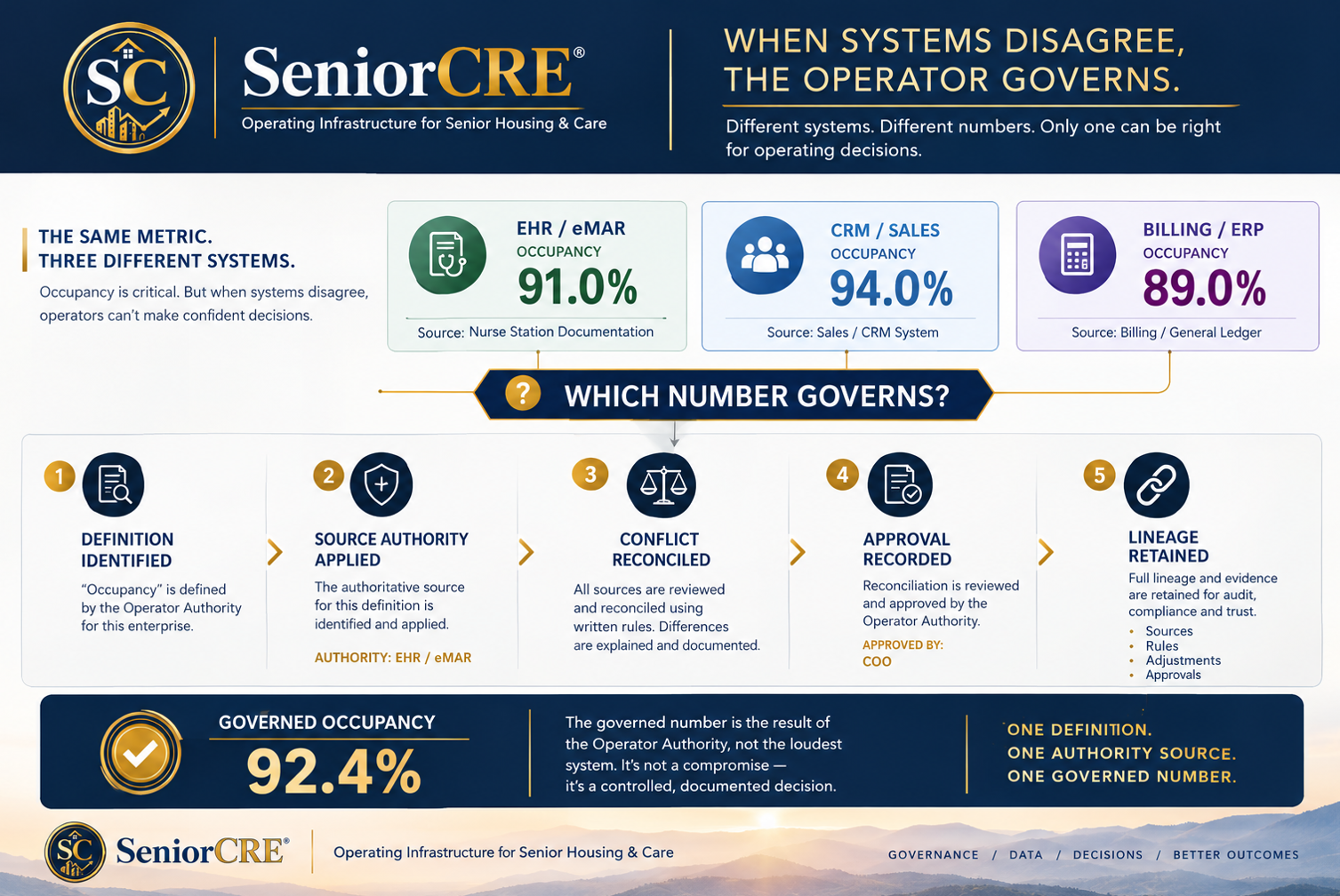
Illustrative governance example. The figures shown are design intent used to demonstrate the governance mechanism — not operator results, customer deployments, production performance, or verified outcomes.
V / The Monday-morning operating experience
One operating problem. One accountable decision.
A hypothetical portfolio example showing how an Operator-Controlled Operating Record can support executive action. It is not a customer account, production deployment, or measured result.
Monday · 08:10
Community labor cost is rising while occupancy is declining. The operating and financial systems report different occupancy measures, and the leadership team must decide which reading applies to staffing and which applies to capital planning.
01 · Detect
Illustrative next stepThe exception reaches the executive team.
Labor utilization, agency expense, operational occupancy, and revenue occupancy are reviewed together before the decision window closes.
Record: The conflicting readings and their source evidence remain visible.
02 · Govern
Demonstrable nowThe authorized executive establishes what applies.
The operating definition governs staffing. The revenue definition governs financial planning. The reconciliation and approval are recorded with lineage.
Record: Authority, reconciliation, approval, and the supporting source references are preserved.
03 · Decide
Illustrative next stepThe COO authorizes a staffing review.
The regional vice president receives a defined assignment, an accountable owner, and an agreed review date based on the governed information.
Record: Authorization is separated from the information that informed it.
04 · Execute and verify
Illustrative next stepLeadership examines what happened next.
At the review date, the team examines labor utilization, occupancy, and financial performance before authorizing any further corrective action.
Record: Execution and outcome measurement require their own evidence; neither is inferred from the governed decision.
Pre-production. No operator runs SeniorCRE in an operator production environment; no operator workflow has been validated; no measured operator outcome or independently validated result is published; no third-party integration is live in operator production; and no PHI is processed in operator production.
Check the current evidence boundaryGovern the systems you have. Or choose SeniorCRE as the system.
Two roads, one principle: the operator decides what governs. Choose the starting scope that fits your community — keeping a working stack or establishing a first system of record. Neither choice commits you to the other.
Road 1 · Keep your systems
Govern What You Have
Keep your EHR/eMAR, payroll, accounting and CRM. Start with one disputed census or labor figure from operator-supplied exports — not a replacement project.
Preserve the source records, agree the definition, name who has authority and record the governing determination with its lineage.
Named third-party connectors remain roadmap, not live. The governing chain still requires proof in an operator workflow.
Review Road 1Road 2 · Choose SeniorCRE as the system
Run on SeniorCRE
For a community moving off paper, start with a bounded scope: resident and operating information entered directly into SeniorCRE, tablet charting and recorded incident notices.
Agree scope, success criteria and exit terms in writing. Keep the paper record alongside, introduce functions in stages and let the operator decide whether to continue.
This starting scope excludes medication/eMAR, billing, payments and payroll, and does not replace accounting, workforce or CRM systems. These functions have not yet been validated in an operator workflow.
Review Road 2 scope and gatesSelected functions, not a whole-stack promise.
SeniorCRE is the operator-controlled operating infrastructure for senior housing & care. Its clinical record surfaces are built; medication administration build-out remains roadmap — not built. After the applicable clinical-safety and acceptance gates are cleared, an operator may select SeniorCRE for defined clinical system-of-record functions. Until then, no community runs SeniorCRE as its clinical system of record.
SeniorCRE is pre-production. Neither road has a completed operator-production deployment. A technical demonstration is not permission to rely on a function in community operations.
Either way, the operator determines what is authoritative. Govern first. Replace only by choice. Two forms of operator authority: data authority — who decides what is true? — and architecture authority — who decides what systems remain or are replaced? Both answers are the operator.
VWhere AI belongs
AI comes after governance, not before it.
Operators make safer decisions when AI works from the Operator-Controlled Operating Record they control. Definitions, authority, reconciliation and lineage turn fragmented records into governed truth. The Operator Authority Chain™ carries that truth into human decisions and authorized execution. An agent acting on an ungoverned number inherits every disagreement above and acts on it faster than a person would.
One record. Four disciplines: Definition. Authority. Reconciliation. Lineage.
VIThe CEO test
Four questions. If any answer is uncomfortable, the Operator-Controlled Operating Record is missing.
01
When two systems report different occupancy, who decides which figure the business uses?
If the answer is "whoever built the report", authority is unassigned.
02
Can you show where a board number came from without asking three people?
Lineage is either attached to the number or reconstructed under pressure.
03
Is a metric defined once for the enterprise, or once per department?
Definition drift is why the same word produces two answers.
04
When AI summarizes your operation, whose version of the truth does it inherit?
Automation accepts whatever record it is handed, then repeats it faster.
Evidence & Provenance
What sits beneath the number that governs?
Evidence. The sources, definitions, timing, lineage and conflicts behind each operating fact, plus the operator who had authority to decide. Integration brings data together; evidence shows what it supports; authority decides what governs.
The operator governs. SeniorCRE records what governs. The operating record is designed; it is not yet implemented in any community or in operator production.
See the evidence architectureVIIOne decision
Decide what governs your business before something else does.
Executive film · 1:44
Make enterprise decisions from a record your organization controls.
Clinical, workforce, financial and asset decisions can draw from the same Governing Record, with risk signals surfaced for authorized review.
Where you come in
- OperatorsNobody loses an assignment over an inconsistent definition. They lose it over NOI. See the three places an ungoverned number leaks, the screen where it gets settled, and what a first conversation covers.See where it leaksFounding Operator Program
- REITs & public ownersOne operating record behind the numbers you publish — the quarterly filing narrative, the supplemental, the earnings call, and the lender pack carrying the same figure.See the REIT view
- Capital & underwritingExpensive problems start invisible. The capital layer reads the same record the operator writes.See the capital layer